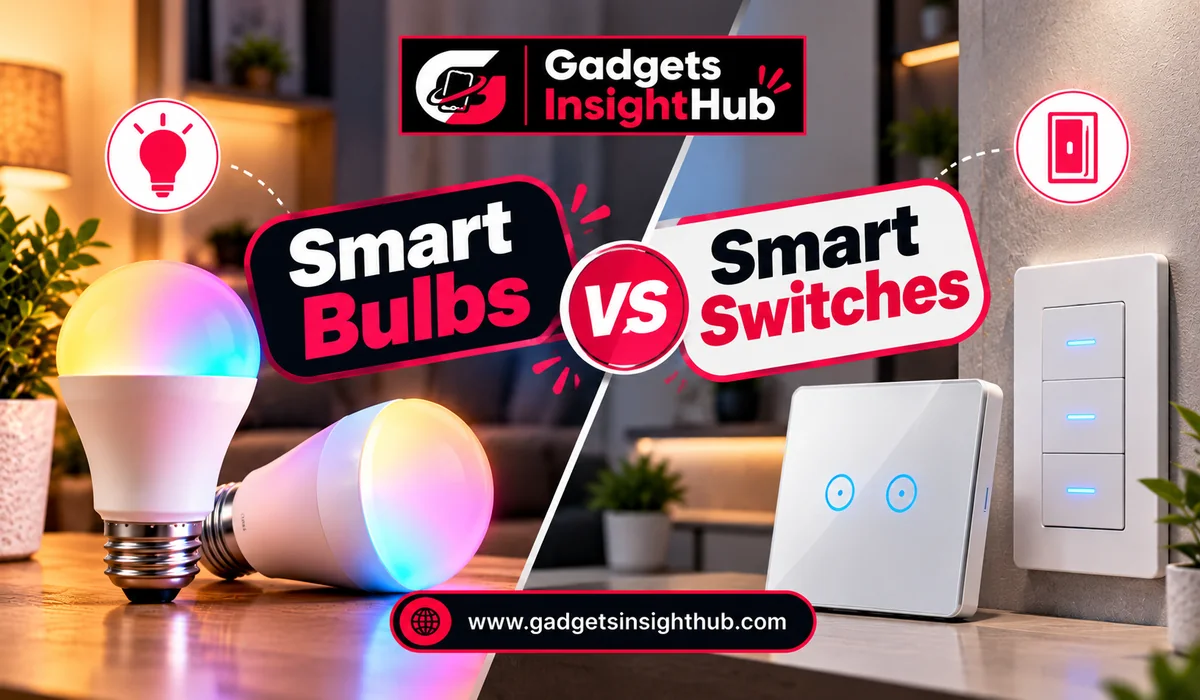
Smart bulbs vs smart switches is a common comparison when you want to make your home lighting more convenient. Both options let you control lights through your phone, create schedules, and automate everyday routines. However, they work differently, and the right choice depends on your existing wiring, lighting preferences, budget, and smart home setup.
Smart bulbs are ideal when you want to change colours, adjust brightness, or create different lighting moods. In contrast, smart switches let you control conventional light fixtures without replacing every bulb. Understanding these differences will help you choose the best solution for your home.
What Are Smart Bulbs?
Smart bulbs are LED bulbs with built-in wireless connectivity. You install them in compatible light fittings and control them using a smartphone app, voice assistant, or smart home automation system.
Many models connect through Wi-Fi or Bluetooth, while others use protocols such as Zigbee or Thread and may require a compatible hub or controller.
Key Features of Smart Bulbs
- Remote control: Turn lights on or off and adjust settings through a compatible app.
- Brightness adjustment: Dim compatible bulbs without installing a separate dimmer.
- Colour options: Some models offer millions of colours and adjustable white-light temperatures.
- Scheduling: Set lights to switch on or off at specific times.
- Automation: Trigger lighting changes through routines or compatible sensors.
- Easy installation: Most smart bulbs fit standard compatible sockets without electrical wiring changes.
Popular Smart Bulb Examples
- Philips Hue White and Color Ambiance
- TP-Link Tapo L530B
- WiZ Color Bulb
- IKEA KAJPLATS Smart LED Bulb
Smart bulbs work particularly well in bedrooms, living rooms, gaming spaces, and other areas where lighting atmosphere matters.
What Are Smart Switches?
Smart switches replace conventional wall switches or use compatible smart control modules. Instead of connecting directly to a smart bulb, they control the electrical supply to a lighting circuit.
This approach allows you to keep using ordinary compatible LED bulbs and existing light fixtures while adding remote control and automation.
Key Features of Smart Switches
- Remote switching: Turn connected lights on or off through a compatible app.
- Voice control: Operate lighting through supported smart assistants.
- Scheduling: Automate lighting based on time or routine.
- Control of multiple lights: One switch can operate several lights on the same circuit.
- Existing bulb compatibility: Standard compatible bulbs can often remain in place.
- Physical control: Family members and guests can continue using a wall switch.
Popular Smart Switch Examples
- TP-Link Tapo S505
- Leviton Decora Smart Wi-Fi Switch
- Lutron Caséta Smart Switch
- Shelly 1 Gen3 smart relay module
Compatibility varies by model, region, wiring, and electrical standards. Some smart switches require a neutral wire, while others support installations without one.
Smart Bulbs vs Smart Switches: Main Differences
| Feature | Smart bulbs | Smart switches |
| Installation | Usually screw into a compatible socket | Often require wiring or an electrical module |
| Colour changing | Available on colour models | Requires compatible colour lighting and controls |
| Dimming | Supported by compatible bulbs | Depends on switch type and bulb compatibility |
| Standard bulbs | Replaced by smart bulbs | Often retained |
| Physical wall control | May lose connectivity if switched off at the wall | Designed to retain physical switch control |
| Multiple lights | Controlled individually or in groups | Can control an entire compatible circuit |
| Wiring changes | Usually unnecessary | May be required |
| Best use | Personalised lighting | Convenient control of existing lighting |
| Initial cost | Can increase when many bulbs are needed | Can be economical for multi-light circuits |
| Automation | Yes | Yes, with supported systems |
Advantages of Smart Bulbs
1. Better Lighting Customisation
Smart bulbs are the better choice if you enjoy changing your lighting throughout the day. For example, you can use warm white light in the evening, brighter white light while working, and coloured lighting for entertainment.
Smart switches generally cannot provide these features on their own because they primarily control electrical power rather than bulb colour.
2. Simple Installation
Most smart bulbs are easy to install. You replace a compatible conventional bulb, connect it to the appropriate app, and configure your preferred settings.
Therefore, they are a practical option for renters or homeowners who do not want to modify electrical wiring.
3. Individual Bulb Control
If you have several lamps or light fittings in one room, smart bulbs can let you control them individually. You can also group compatible bulbs to create coordinated lighting scenes.
This flexibility is useful when different parts of a room need different brightness levels.
4. Useful Lighting Routines
You can schedule smart bulbs to turn on before you arrive home, dim gradually in the evening, or create a morning lighting routine. Compatible systems may also use motion sensors or other triggers.
However, advanced routines depend on the bulb, app, network, and smart home platform.
Disadvantages of Smart Bulbs
1. Wall Switches Can Interrupt Smart Control
Smart bulbs usually need continuous electrical power to remain connected. If someone turns off the conventional wall switch, the bulb loses power and may become unavailable through the app until the switch is turned on again.
This can be inconvenient in rooms where people regularly use physical switches.
2. Cost Increases With More Bulbs
If one room has six or eight bulbs, replacing every bulb with a smart model can become expensive. The cost may be especially high if you want colour-changing bulbs throughout your home.
3. Compatibility Matters
You need to check the bulb base, fitting size, dimmer compatibility, and wireless requirements. Some smart bulbs also require a hub for particular features or integrations.
Advantages of Smart Switches
1. Control Existing Lighting
Smart switches let you upgrade compatible lighting circuits without replacing every conventional bulb. This can be a cost-effective approach when one switch controls several lights.
2. Physical and App-Based Control
A smart switch retains a familiar wall control while adding app-based operation and supported automation. As a result, visitors and household members can use the lights without learning a new system.
3. Convenient Whole-Circuit Control
If one switch controls multiple ceiling lights, a compatible smart switch can control them together. You do not necessarily need to purchase a separate smart bulb for every light.
4. Suitable for Everyday Lighting
For basic tasks such as switching hallway lights on at sunset or turning off a bedroom light on a schedule, a smart switch can provide the required automation without colour-changing features.
Disadvantages of Smart Switches
1. Installation Can Be More Complicated
Some smart switches require changes to household wiring. You may need a neutral wire, a suitable wall box, or a compatible circuit configuration.
For safety, have a qualified electrician install a wired smart switch if you are not trained to work on electrical circuits.
2. Limited Colour Control
A standard smart switch cannot independently change the colour or colour temperature of a conventional bulb. Those features require compatible smart lighting and a control arrangement designed to support them.
3. Existing Wiring and Fixtures Matter
Not every smart switch works with every electrical installation. Older wiring, multi-way switching arrangements, dimmable LEDs, and local voltage requirements can affect compatibility.
Smart Bulbs vs Smart Switches: Which Is More Affordable?
The cheaper option depends on how many lights you want to automate and whether installation work is required.
Consider a room with six ceiling lights. Replacing all six bulbs with smart bulbs means paying for six devices. A single smart switch controlling the same compatible lighting circuit may cost less, although installation charges can increase the total.
Smart bulbs may be more economical for a single bedside lamp or a small number of decorative lights. Smart switches can offer better value when you want to automate several ordinary lights together.
Remember to compare the full cost, including any hub, electrician, subscription, or replacement accessories.
Smart Bulbs vs Smart Switches: Which Is Better for Different Rooms?
| Room or area | Better option | Why |
| Bedroom | Smart bulbs | Adjustable brightness and relaxing lighting scenes |
| Living room | Either | Bulbs suit colour effects; switches suit ordinary ceiling lights |
| Kitchen | Smart switches | Convenient control of several standard lights |
| Hallway | Smart switches | Simple scheduled on/off control |
| Gaming room | Smart bulbs | Colour effects and custom scenes |
| Rental property | Smart bulbs | Easier installation and removal |
| Large ceiling-light circuit | Smart switch | Can control multiple compatible lights together |
| Bedside lamp | Smart bulb | Simple installation and individual control |
These are general recommendations. Your wiring, fixtures, budget, and preferred control method may lead to a different choice.
Can You Use Smart Bulbs and Smart Switches Together?
Yes, but you need to choose compatible products and configure them correctly.
A conventional smart switch that cuts power to a smart bulb can interrupt the bulb’s wireless connection. To avoid this, you could use a compatible smart switch with a smart-bulb mode, a wireless wall controller, or an automation setup designed to keep smart bulbs powered.
For example, you could use colour-changing smart bulbs in your living room while using a wired smart switch for standard kitchen ceiling lights. This lets you choose the control method that best fits each space.
Before combining products, check the manufacturer’s instructions and compatibility requirements.
Frequently Asked Questions
1. Are smart bulbs better than smart switches?
Smart bulbs are better for colour changing, brightness adjustment, and personalised lighting scenes. Smart switches are better for controlling conventional lights and automating an entire compatible lighting circuit.
2. Do smart switches work with normal LED bulbs?
Many smart switches work with compatible standard LED bulbs. However, dimming performance, electrical requirements, and compatibility depend on the switch and the bulbs installed.
3. Do smart bulbs work when Wi-Fi is down?
Some smart bulbs support local Bluetooth or other direct connections, while others rely on Wi-Fi or a hub for particular functions. Basic operation may still be possible through a physical switch, but app control and remote access can be limited.
4. Can a smart switch control multiple lights?
Yes. A smart switch can control multiple lights connected to the same compatible circuit, provided the circuit and total electrical load meet the switch’s specifications.
5. Which is better for a rented home?
Smart bulbs are usually more suitable for rented homes because installation generally does not require changing the wiring. You can remove the bulbs when you move, provided you leave the original fittings in place.