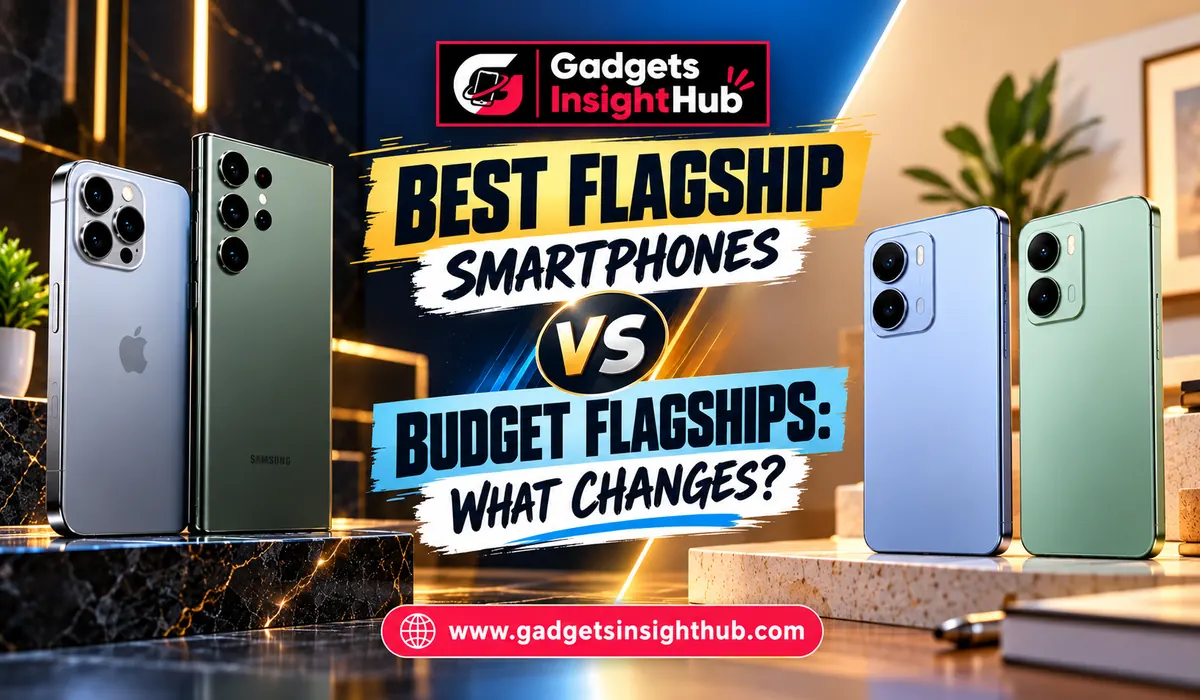
Buying a premium smartphone in 2026 does not always mean spending more than ₹1 lakh. Many budget flagship smartphones now offer powerful processors, bright AMOLED displays, fast charging, and capable cameras at lower prices. However, premium flagship phones still have advantages in areas such as camera versatility, build quality, advanced features, and overall refinement.
Understanding the difference between flagship smartphones and budget flagships can help you spend your money wisely. The price gap may look significant, but the real difference depends on how you use your phone. For example, gamers may benefit from stronger sustained performance, while photography enthusiasts may prefer a premium camera system.
In this guide, we compare both categories, explain what changes as you spend more, and help you decide which type of smartphone offers better value in 2026.
What Is a Flagship Smartphone?
A flagship smartphone represents a manufacturer’s premium offering. It usually combines advanced hardware, a high-quality display, sophisticated cameras, and the latest software features available for that product line.
Examples include the Samsung Galaxy S26 Ultra, Apple iPhone 18 Pro Max, and other top-tier devices from major smartphone brands.
Flagship phones are designed for users who want an extensive set of features rather than simply good everyday performance. They often include specialised camera hardware, premium materials, wireless charging, advanced video recording, and enhanced water resistance.
Common flagship features
- Top-tier processors: Designed for demanding games, multitasking, AI features, and creative applications.
- Advanced camera systems: May include high-quality main sensors, ultrawide cameras, and dedicated telephoto lenses.
- Premium displays: Often feature high brightness, accurate colours, adaptive refresh rates, and advanced HDR support.
- High-quality construction: Premium materials, carefully designed frames, and refined finishes.
- Advanced connectivity: May include modern Wi-Fi standards, wireless charging, and additional connectivity features.
- Extended software support: Many premium models offer several years of operating system and security updates.
A flagship is worth considering if you want the strongest combination of hardware and features from a particular manufacturer. However, some of its advanced capabilities may be unnecessary for everyday tasks.
What Is a Budget Flagship Smartphone?
A budget flagship, often called a flagship killer or value flagship, aims to deliver a premium smartphone experience at a more accessible price. These phones usually prioritise performance, display quality, battery life, and selected high-end features while making compromises in other areas.
In the Indian market, this category commonly includes phones in the approximate ₹40,000–₹70,000 range, although prices vary by brand, model, and sale offers.
Examples worth comparing include the OnePlus 15R, Motorola Signature, and other performance-focused premium phones available in this price segment.
Common budget flagship features
- Powerful processors: Often provide excellent performance for gaming and multitasking.
- High-refresh-rate displays: Frequently include AMOLED panels with smooth scrolling.
- Large batteries: Many models prioritise endurance and fast charging.
- Capable cameras: Main cameras can produce excellent results, although secondary cameras may be less advanced.
- Premium design: Some models offer metal frames, glass finishes, and water resistance.
- Competitive pricing: Manufacturers focus on delivering strong specifications without including every premium feature.
A budget flagship is not simply an ordinary budget phone with a higher price. It is designed to provide a near-premium experience while focusing spending on the features that matter most to its target audience.
Flagship vs Budget Flagship: Key Differences
The biggest differences usually appear in camera versatility, specialised features, materials, and overall refinement. Performance and battery life can be surprisingly competitive in the lower-priced category.
| Feature | Premium flagship | Budget flagship |
| Processor | Usually top-tier chipset | Powerful flagship or upper-tier chipset |
| Display | Advanced panel with premium features | Often excellent AMOLED display |
| Main camera | Usually highly refined | Can be similarly capable in good light |
| Telephoto camera | More advanced zoom options on some models | May have a basic telephoto or none |
| Video recording | More advanced controls and formats on some models | Good everyday video, with fewer advanced options |
| Build quality | Often premium materials and refined construction | Can be premium, with selected compromises |
| Battery | Depends on model and design priorities | Often prioritises large capacity and endurance |
| Charging | May offer wired and wireless options | Fast wired charging is common on some models |
| Special features | More extensive premium features | Selected features focused on value |
| Price | Usually significantly higher | Lower cost for much of the core experience |
These are general patterns, not universal rules. Some budget flagships outperform more expensive phones in battery capacity or wired charging, while some premium devices prioritise camera quality and software integration instead.
If you prefer a smaller device without compromising everyday usability, explore these 8 best compact smartphones for everyday use to compare their features, performance, and practicality against larger flagship models.
1. Performance: How Much Faster Is a Flagship?
Performance is one of the main reasons people consider premium smartphones. Flagship processors are designed to handle demanding applications, advanced image processing, AI workloads, and intensive games.
However, the difference is not always obvious during everyday use. Opening messaging apps, browsing websites, watching videos, and switching between common applications can feel equally smooth on a capable budget flagship.
Where premium flagships can have an advantage
- Sustained gaming: Some premium models maintain high performance more consistently during long gaming sessions.
- Advanced AI processing: Powerful hardware may support more demanding on-device AI tasks.
- Video editing: Higher processing capacity can reduce waiting time when exporting large projects.
- Graphics performance: Premium chipsets may support higher graphics settings in demanding games.
- Long-term headroom: Strong hardware can provide additional capacity for future applications.
A budget flagship can still be an excellent choice for gaming and multitasking. Before spending more, compare sustained performance and thermal management rather than relying only on benchmark scores.
2. Camera Quality: The Biggest Reason to Upgrade
Camera systems often provide one of the clearest distinctions between premium and budget flagships. Both categories can capture excellent daytime photographs, but premium models may offer more consistent results across difficult conditions and different focal lengths.
For example, a budget flagship may have an excellent main camera but lack a dedicated telephoto lens. A premium flagship may include a more capable zoom camera, larger sensors, improved stabilisation, and advanced video features.
What changes as you spend more?
- Low-light photography: Premium models may retain more detail and control noise more effectively.
- Optical zoom: Dedicated telephoto cameras can improve portraits and distant shots.
- Ultrawide photography: Higher-end models may offer better detail and more consistent colours across lenses.
- Video recording: Premium phones may provide advanced recording formats, better stabilisation, and more consistent exposure.
- Portrait processing: Better lens options and image processing can improve subject separation and skin tones.
However, price alone does not guarantee better photographs. A budget flagship with a well-optimised main camera can outperform a premium phone in particular situations.
If you mainly take casual photographs and post them on social media, a budget flagship may be sufficient. If you regularly photograph events, travel, wildlife, or create professional video content, a premium camera system may justify the extra expense.
3. Display Quality: Premium Does Not Always Mean Better
Display quality is another area where the gap between the two categories has narrowed. Many budget flagships already offer AMOLED displays, high refresh rates, and sharp resolutions.
Premium phones may differentiate themselves through improved colour accuracy, higher sustained brightness, more advanced anti-reflective coatings, or additional display technologies.
Display features worth comparing
- Brightness: Important for viewing the screen outdoors.
- Colour accuracy: Particularly useful for photo editing and content creation.
- Refresh rate: A 120Hz panel can provide smooth scrolling and supported gaming.
- HDR support: Helps compatible content display a wider range of brightness and colours.
- Screen protection: Can affect durability during everyday use.
Do not assume that a premium flagship automatically has a better screen. Compare independent display measurements and real-world visibility. If both phones offer excellent brightness, colour reproduction, and smooth motion, you may not notice a meaningful difference during ordinary use.
4. Battery Life and Charging Speed
Battery performance does not always favour the more expensive phone. Some budget flagships include larger batteries and faster wired charging because manufacturers prioritise endurance and convenience.
Premium models may focus on a combination of battery efficiency, wireless charging, slim design, and software optimisation. Consequently, the best choice depends on the particular devices you compare.
What should you check?
- Battery capacity: A larger battery can help, but processor and display efficiency also matter.
- Charging speed: Compare actual charging times, not only the advertised wattage.
- Wireless charging: Check whether it is available if you use charging pads.
- Battery endurance: Look for independent tests involving video, gaming, and mobile data.
- Battery management: Check for features that help maintain battery health over time.
If you travel frequently or spend long hours gaming, a budget flagship with excellent endurance may be a better choice than a premium model with a smaller battery.
5. Build Quality and Durability
Premium flagship phones often use carefully finished materials and include advanced protection features. However, budget flagships can also offer metal frames, glass backs, and water resistance.
The differences depend on the specific model rather than its price category alone.
Premium models may offer advantages such as more sophisticated finishes, improved screen protection, or more comprehensive water resistance. Some budget flagships, meanwhile, focus on practical durability and may include large batteries or robust construction.
Before buying, check:
- The phone’s official dust and water resistance rating.
- The type of screen protection used.
- The cost and availability of replacement screens.
- The manufacturer’s warranty terms.
- The availability of authorised service centres.
A premium phone can still break if dropped, while a less expensive phone can remain reliable with sensible care. Consider repair costs alongside the purchase price.
6. Software Support and AI Features
Software support is increasingly important when buying a smartphone in 2026. A phone should receive security updates and operating system upgrades for a period that matches how long you intend to keep it.
Premium phones often receive extensive support, but budget flagships can also offer competitive update commitments. Therefore, check the policy for the exact model rather than assuming more expensive phones always receive longer support.
AI features can also differ between devices. Premium models may support more demanding on-device processing or offer a broader selection of camera and productivity tools. However, some AI features depend on cloud services, software versions, or subscriptions.
Check these details before buying
- The number of promised operating system upgrades.
- The length of the security update period.
- Which AI tools are included without additional payment.
- Whether advanced AI features require an internet connection.
- How frequently the manufacturer delivers updates.
If you intend to keep your phone for four or five years, software support should be part of your decision. A budget flagship with a strong update commitment may offer better long-term value than an older premium model nearing the end of its support period.
7. Price and Overall Value
Price is where budget flagships have their strongest advantage. They aim to provide excellent performance and a premium everyday experience without charging for every specialised feature.
Premium flagships cost more because of their advanced hardware, camera systems, materials, and additional features. However, the extra expense is worthwhile only if those advantages matter to you.
Consider this practical comparison:
- Choose a budget flagship if you want powerful performance, a quality display, fast charging, and good everyday cameras.
- Choose a premium flagship if you need advanced zoom photography, specialised video tools, premium construction, or particular high-end features.
- Consider an older flagship if its discounted price is competitive and it still has sufficient software support remaining.
When comparing prices in India, use the current selling price rather than the original launch price. Discounts, exchange offers, and bank promotions can change which phone offers the best value.
Which One Should You Buy in 2026?
The best choice depends on your priorities and how much you are willing to spend.
| Your priority | Better starting point |
| Everyday apps and social media | Budget flagship |
| High-performance gaming | Compare both categories for sustained performance |
| Advanced photography and optical zoom | Premium flagship |
| Long battery life | Compare real-world endurance in both categories |
| Fast wired charging | Often a strong budget flagship feature |
| Professional video recording | Premium flagship |
| Long software support | Check the exact update policy |
| Best value for money | Budget flagship or discounted older flagship |
For many buyers, a budget flagship offers the best balance of price and performance. Premium flagships make more sense when you need specific features that cheaper models cannot match.
Frequently Asked Questions
1. What is the main difference between a flagship and a budget flagship?
A premium flagship generally offers more advanced camera hardware, specialised features, and greater overall refinement. A budget flagship focuses on delivering strong performance and essential premium features at a lower price.
2. Are budget flagship phones good for gaming?
Yes. Many budget flagships use powerful processors and high-refresh-rate displays that handle demanding games well. Check sustained frame rates, heat management, and battery endurance before choosing a model.
3. Do premium flagship phones have better cameras?
They often offer more versatile camera systems, especially for optical zoom, low-light photography, and advanced video recording. However, some budget flagships can produce excellent images with their main cameras.
4. Is a previous-generation flagship worth buying in 2026?
It can be a smart purchase if the current selling price is attractive, the battery and hardware are in good condition, and software support will continue for long enough. Check the warranty and remaining update period before buying.
5. Is a budget flagship enough for everyday use?
For most people, yes. A good budget flagship can comfortably handle communication, browsing, streaming, photography, multitasking, and many games. Consider a premium flagship only if its additional features will make a meaningful difference to your daily use.