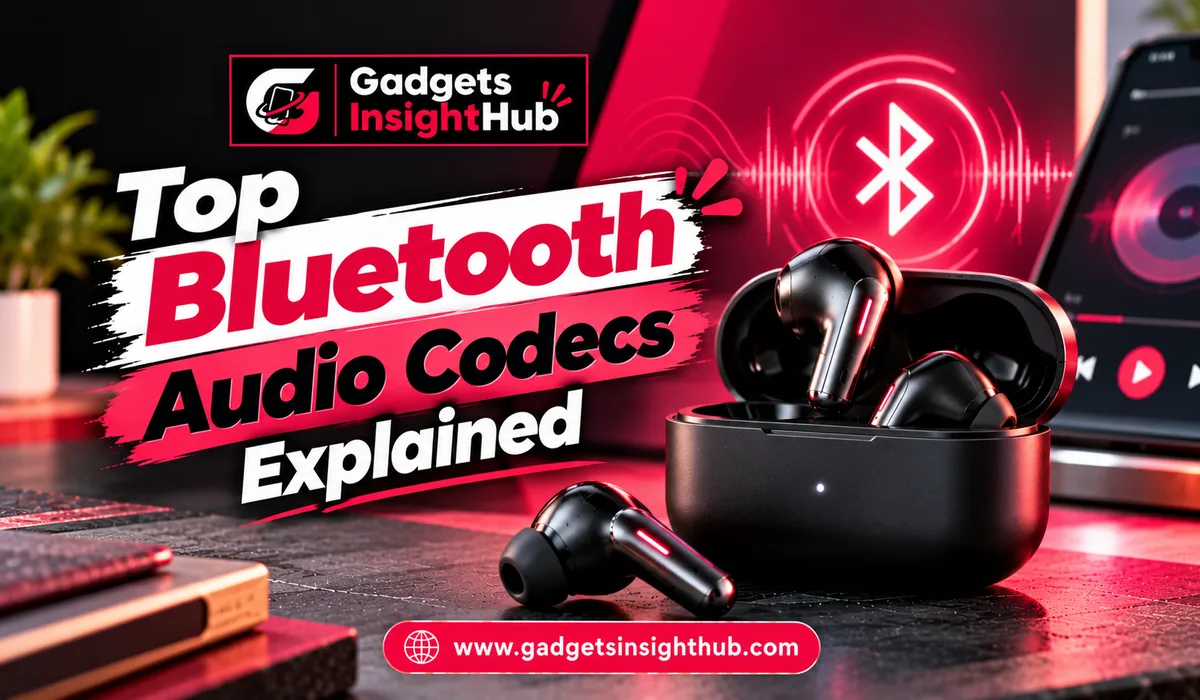
Bluetooth audio codecs play an important role in how wireless headphones and earbuds deliver sound. Whether you listen to music, watch videos, play games, or make phone calls, the codec helps determine how audio travels from your smartphone or computer to your wireless audio device. Different codecs use different methods to compress and transmit sound, which can affect audio quality, latency, and connection performance.
However, choosing the right Bluetooth codec can be confusing because many earbuds advertise support for technologies such as AAC, aptX, LDAC, and LC3. A codec with impressive specifications does not automatically guarantee better sound. Your phone, headphones, audio source, and listening environment all influence the final experience. Understanding the main Bluetooth audio codecs can help you compare wireless headphones and earbuds more confidently.
1. What Is a Bluetooth Audio Codec?
A Bluetooth audio codec is a technology that encodes and decodes digital audio for wireless transmission. Before audio reaches your headphones, the transmitting device processes the sound into a format that can be sent over Bluetooth. Your headphones then decode the data and convert it into audio you can hear.
Most codecs use some form of compression to make audio transmission more efficient. Different codecs balance audio quality, data rate, latency, processing requirements, and connection reliability in different ways.
For example, one codec may prioritise broad compatibility, while another supports higher bitrates or more efficient transmission. These differences can matter, but they do not tell the whole story. Headphone tuning, driver quality, fit, and the original audio recording also affect what you hear.
2. SBC: The Standard Bluetooth Audio Codec
SBC, or Subband Codec, is the basic audio codec supported by traditional Bluetooth A2DP audio devices. It provides broad compatibility across smartphones, computers, headphones, and speakers.
SBC is designed to deliver practical wireless audio without requiring specialised hardware or licensing arrangements for optional codecs. Its performance depends on implementation and connection conditions, but it is generally sufficient for everyday listening, including music streaming, podcasts, and videos.
Key characteristics
- Broad compatibility with Bluetooth audio devices
- Suitable for everyday music and spoken audio
- No specialised codec support required beyond the standard Bluetooth audio profile
- Audio quality and bitrate depend on the implementation
SBC is useful because it provides a common fallback when two devices do not share another supported codec. If you mainly listen to streaming music casually, you may find it perfectly adequate. However, users seeking particular audio features may prefer a codec that better matches their device and listening requirements.
3. AAC: Popular With Apple Devices
AAC stands for Advanced Audio Coding. It is widely used in digital music and video services and is supported by many wireless headphones and earbuds. AAC can provide good audio quality at practical bitrates, making it a popular option for everyday wireless listening.
Apple devices commonly use AAC when connecting to compatible Bluetooth audio products. Android devices also support AAC, although performance can vary depending on the phone, operating system, and headphone implementation.
AAC does not guarantee better sound than SBC in every situation. The quality of the encoder, decoder, audio source, and hardware all influence the result.
Key characteristics
- Widely supported by Apple devices and many Android products
- Commonly used for music and video audio
- Offers efficient compression for everyday listening
- Performance can vary across devices
AAC is worth considering if you use an iPhone, iPad, or other compatible device. Rather than choosing headphones solely because they support AAC, compare their overall sound quality, comfort, and microphone performance as well.
4. aptX: A Family of Qualcomm Audio Codecs
aptX is a family of Bluetooth audio codecs associated with Qualcomm technology. Different versions provide different capabilities, so the name aptX alone does not identify one uniform level of performance.
Standard aptX is designed to deliver efficient audio transmission, while other versions introduce additional features. Support depends on both the transmitting device and the headphones. If either device lacks the required codec, the connection generally uses another mutually supported option.
Key characteristics
- Available in multiple versions
- Supported by selected smartphones, computers, and headphones
- Designed for efficient wireless audio transmission
- Actual performance depends on the codec version and device implementation
aptX can be useful if your phone and headphones both support it. However, check the exact version rather than assuming every aptX-enabled product supports the same features.
5. aptX HD: Designed for Higher-Resolution Audio
aptX HD is a version of aptX designed to support higher-resolution audio transmission than standard aptX. It can transmit audio at up to 24-bit resolution under supported conditions, making it attractive to listeners who want more detailed wireless audio.
However, higher bit depth does not automatically mean that the sound will be noticeably better. The recording, encoder, headphone design, and listening environment all influence the result. A well-tuned pair of headphones using another codec may sound better than a poorly tuned model supporting aptX HD.
Key characteristics
- Supports audio transmission up to 24-bit under supported conditions
- Designed for compatible devices and headphones
- Requires codec support at both ends of the connection
- Does not guarantee an audible improvement for every listener
aptX HD may suit listeners who have compatible equipment and high-quality audio sources. If you mainly stream compressed music or podcasts, comfort and headphone tuning may make a greater practical difference.
6. aptX Adaptive: Balancing Quality and Connection Stability
aptX Adaptive is designed to adjust audio transmission according to factors such as content requirements and wireless conditions. Its goal is to balance audio quality, latency, and connection stability rather than using one fixed operating point for every situation.
This flexibility can be useful when you move between different environments or use headphones for several activities. However, the available capabilities depend on the exact implementation, device support, and settings.
Key characteristics
- Designed to adapt transmission to operating conditions
- Balances audio quality and connection performance
- Supports lower-latency configurations on compatible devices
- Requires compatible hardware at both ends
aptX Adaptive is worth considering if you want versatile wireless audio and your devices support it. Check the specifications carefully, because support for one aptX version does not necessarily mean support for every other version.
7. LDAC: Sony’s High-Bitrate Bluetooth Codec
LDAC is a Bluetooth audio codec developed by Sony. It supports higher transmission bitrates than many traditional Bluetooth audio configurations, including modes up to 990 kbps under supported conditions. It is designed to transmit higher-resolution audio with less compression than lower-bitrate modes.
LDAC can operate at different bitrates depending on the selected setting and wireless conditions. A higher bitrate can carry more audio data, but it also requires a suitable connection. The device may use a lower setting when the wireless environment makes the highest bitrate less reliable.
Key characteristics
- Supports selectable transmission modes
- Can reach up to 990 kbps under supported conditions
- Designed for higher-resolution wireless audio
- Requires compatible source and receiving devices
LDAC may appeal to listeners who use compatible Android devices and headphones. However, the highest bitrate is not always necessary, and it does not automatically produce a clearly audible improvement. Headphone tuning and the quality of the original recording remain important.
8. LC3: The Codec for Bluetooth LE Audio
LC3 stands for Low Complexity Communication Codec. Bluetooth LE Audio uses a newer Bluetooth audio framework that improves efficiency and expands audio capabilities.
LC3 is intended to deliver good audio quality at relatively low data rates. This can help make wireless transmission more efficient, although actual battery life depends on the complete device design rather than the codec alone.
Bluetooth LE Audio also supports capabilities such as broadcast audio through Auracast on compatible devices. However, LC3 support alone does not guarantee that every LE Audio feature is available.
Key characteristics
- Designed for Bluetooth LE Audio
- Focuses on audio quality at efficient bitrates
- Supports low-power audio applications
- Can be used with compatible LE Audio features
LC3 is worth understanding if you are buying newer wireless earbuds or headphones. Check the product specifications for Bluetooth LE Audio support and the features available with your particular phone or computer.
9. Bluetooth Codec Comparison Table
| Codec | Main advantage | Important consideration |
| SBC | Broad compatibility | Quality varies by implementation |
| AAC | Good everyday audio and broad device support | Performance can vary across devices |
| aptX | Efficient audio transmission | Check the exact version |
| aptX HD | Supports higher-resolution transmission | Requires compatible devices |
| aptX Adaptive | Balances quality and connection conditions | Features depend on implementation |
| LDAC | High-bitrate audio transmission | Highest bitrate may not always be stable |
| LC3 | Efficient Bluetooth LE Audio | Requires compatible LE Audio hardware |
10. How to Choose the Right Bluetooth Audio Codec
The best codec for you depends on your devices and how you use your headphones. Before paying extra for codec support, check whether your smartphone, computer, and headphones all support the same option.
If you use Apple devices, AAC support is a sensible consideration. If you use a compatible Android phone, you may have access to LDAC or certain aptX versions. For newer Bluetooth LE Audio products, LC3 support may be relevant.
Also consider your listening habits. For casual streaming, podcasts, and video calls, codec differences may be less noticeable than comfort, microphone quality, and connection stability. High-quality music listening, compare the codec options alongside headphone tuning and source quality. For gaming, check latency and connection type because the codec name alone does not guarantee responsive audio.
Remember that a Bluetooth connection normally selects a codec supported by both devices. Buying headphones with an advanced codec will not provide its benefits if your phone or computer cannot transmit audio using that codec.
Bluetooth audio codecs affect how audio is transmitted wirelessly, while headphone design and battery performance influence your overall listening experience. Check out the 10 best Bluetooth headphones for long listening sessions to explore options for comfortable, extended use.
Frequently Asked Questions
1. Which Bluetooth audio codec offers the best sound quality?
LDAC and aptX HD can support higher-resolution or higher-bitrate transmission under compatible conditions, but no codec guarantees the best sound in every setup. Headphone tuning, source quality, and device compatibility also matter.
2. Is AAC better than SBC?
AAC can provide good audio quality and is widely used, especially with Apple devices. However, the difference depends on implementation, and SBC can still deliver satisfactory sound for everyday listening.
3. Does LDAC improve sound quality on every phone?
No. Your phone and headphones must support LDAC, and the selected bitrate and wireless conditions affect performance. The improvement may also be difficult to hear with some recordings or headphones.
4. Which Bluetooth codec is best for gaming?
The best choice depends on latency and device compatibility rather than audio quality alone. Dedicated low-latency wireless connections may be preferable for competitive gaming, while some Bluetooth configurations offer suitable performance for casual play.
5. How can you check which codec your earbuds are using?
Check your device’s Bluetooth settings and audio options. Some Android phones show the active codec in developer settings when a compatible device is connected, while other platforms may not display this information directly.