
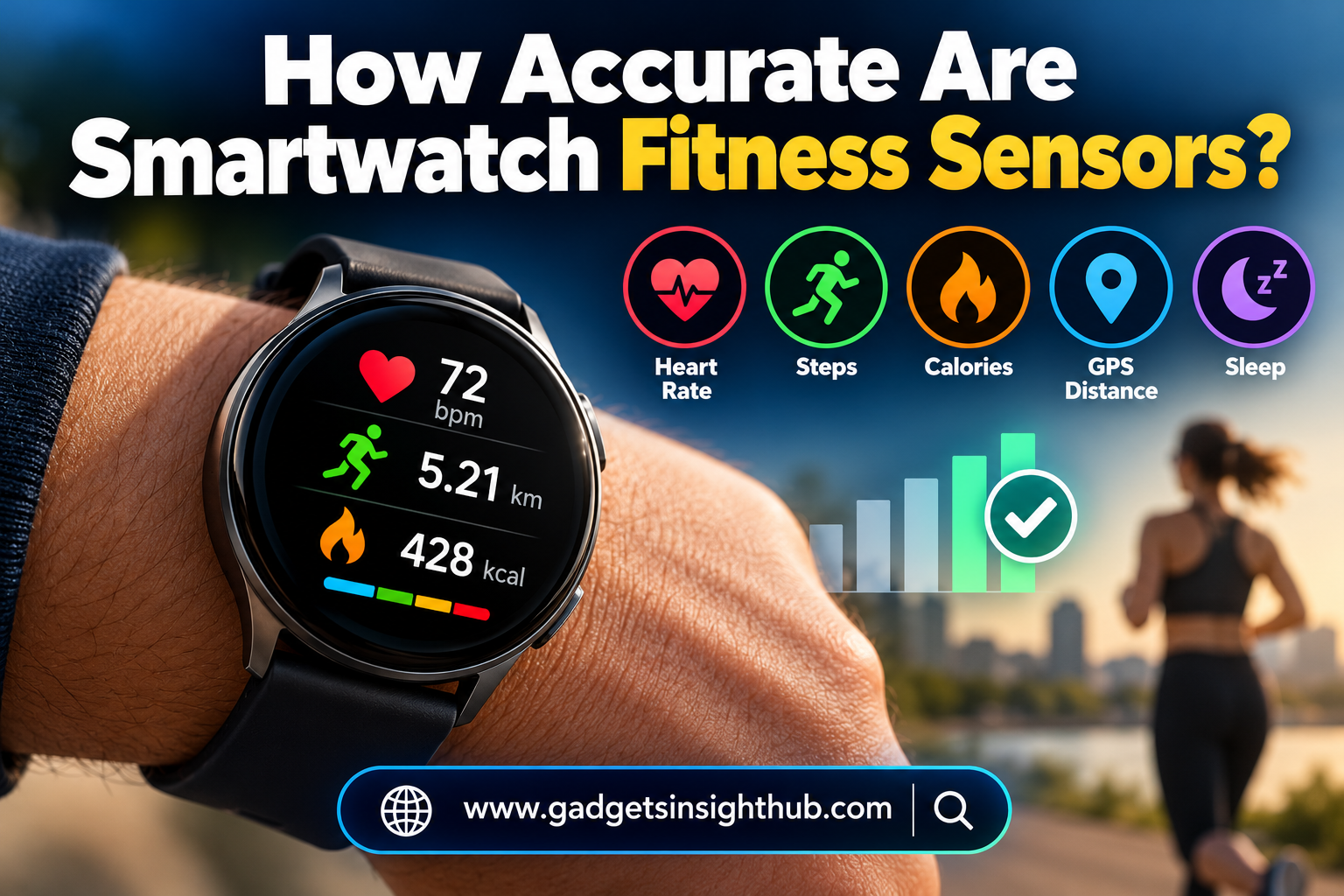
Smartwatches have become popular tools for monitoring fitness, tracking daily movement, and understanding personal health patterns. Modern devices can measure heart rate, count steps, estimate calories burned, record GPS routes, and analyse sleep. These features help users follow exercise routines and observe changes in their activity over time. However, an important question remains: how accurate are smartwatch fitness sensors?
The answer depends on the measurement, the device, and the conditions in which it is used. Some smartwatch features can provide useful estimates during everyday activities, while others become less reliable during intense exercise or unusual movements. Understanding these differences helps users interpret their results realistically and avoid relying too heavily on individual readings.
1. Heart Rate Monitoring Accuracy
Heart rate monitoring is one of the most widely used smartwatch fitness features. Most smartwatches use optical sensors that shine light into the skin and measure changes in reflected light caused by blood circulation. This technique, commonly called photoplethysmography, estimates the number of heartbeats per minute.
During activities such as walking, resting, and steady running, many modern smartwatches can provide reasonably useful heart rate estimates. These readings help users observe exercise intensity and identify general trends.
However, accuracy can decrease during activities involving rapid wrist movement, sudden changes in intensity, or irregular contact between the sensor and skin. Strength training, interval workouts, and exercises involving repeated wrist flexion can create challenges.
Factors such as strap tightness, skin characteristics, cold temperatures, and sensor placement can also affect readings. A loose watch may move during exercise, while excessive tightness can cause discomfort.
For more demanding training, a compatible chest-strap heart rate monitor may provide more consistent readings because it measures electrical signals associated with heart activity.
Smartwatch heart rate data is useful for general fitness monitoring, but users should recognise that individual readings are estimates rather than perfect measurements.
2. Step Counting Accuracy
Step counting is a basic smartwatch function that helps users measure daily movement. Devices generally use accelerometers and motion-detection algorithms to identify patterns associated with walking and running.
During normal walking, step counters often provide useful estimates. They can help users compare activity levels between days and maintain consistent movement goals.
Nevertheless, step counts are not always exact. Hand movements, pushing a shopping trolley, carrying bags, or walking with restricted arm movement can affect detection. Some devices may count certain repetitive movements as steps, while others may miss steps when the wrist remains relatively still.
Walking speed and individual movement patterns can also influence results.
The best way to use step counts is to focus on consistency rather than treating a particular number as perfectly accurate. If you use the same device regularly, changes in your activity may still be meaningful even when the absolute count contains some error.
For everyday fitness, step tracking is a convenient way to encourage movement. It should be viewed as a practical estimate, not an exact record of every step taken.
3. Calories Burned Estimates
Smartwatches commonly estimate calories burned during exercise and throughout the day. These calculations may use information such as heart rate, age, weight, height, recorded activity, and movement patterns.
Although these estimates can provide a general overview of activity, calorie expenditure is difficult to measure precisely using wrist sensors alone.
Different people can burn different amounts of energy while performing the same exercise. Fitness level, body composition, movement efficiency, and exercise intensity all influence energy expenditure.
Algorithms also differ between manufacturers. Two smartwatches may therefore display different calorie estimates for the same workout.
These differences matter when people use smartwatch data to manage nutrition or weight. Consuming or restricting food based entirely on estimated exercise calories can lead to misleading conclusions.
Instead, use calorie readings as broad indicators of activity rather than exact measurements. Longer-term changes in body weight, exercise consistency, and other relevant information provide additional context.
Smartwatch calorie estimates are useful for comparing activity patterns, but they should not be treated as laboratory-grade measurements.
4. GPS Tracking Accuracy
GPS tracking allows smartwatches to record outdoor routes, distance, pace, and location. It is particularly valuable for runners, cyclists, hikers, and people who enjoy outdoor exercise.
Accuracy depends on the watch’s satellite receiver, antenna design, software, and surrounding environment. Open areas with a clear view of the sky generally provide better conditions than narrow streets or dense forests.
Tall buildings can reflect satellite signals, creating positioning errors in urban environments. Trees, mountains, and other obstructions can also affect signal quality.
Some smartwatches support multiple satellite systems or advanced positioning modes that may improve performance under suitable conditions. Others rely on a connected smartphone for certain location functions.
GPS distance measurements can differ between devices, particularly on routes with frequent turns or poor satellite visibility. Short workouts may show proportionally larger errors because even a small distance difference can significantly affect the final result.
For better results, allow the watch to establish a GPS connection before starting an outdoor workout. Compare repeated sessions under similar conditions rather than expecting every recorded route to match perfectly.
5. Sleep Tracking Accuracy
Sleep tracking helps users understand their sleep schedules and estimated sleep duration. Smartwatches generally combine movement sensors with heart rate measurements and other available signals to estimate when a person is asleep or awake.
Many devices can provide useful information about sleep timing and overall duration. These summaries may help users recognise irregular routines or observe how sleeping habits change over time.
However, identifying sleep stages is more complicated. Light sleep, deep sleep, and rapid eye movement sleep are normally distinguished using several physiological measurements, including brain activity, during clinical sleep studies.
A smartwatch does not usually measure brain activity directly. It estimates sleep stages using indirect signals and proprietary algorithms.
As a result, sleep-stage estimates can differ from clinical measurements and between smartwatch brands. Quiet wakefulness may also be mistaken for sleep.
For everyday use, focus on consistent sleep schedules, estimated total sleep duration, and broad patterns across multiple nights. Avoid becoming overly concerned about a single sleep score.
If you experience persistent sleep problems or excessive daytime tiredness, a smartwatch cannot diagnose the underlying cause. A qualified healthcare professional can help determine whether further assessment is appropriate.
6. Blood Oxygen and Other Health Measurements
Some smartwatches offer blood oxygen estimates, skin temperature trends, electrocardiogram recordings, or notifications related to particular heart rhythm patterns.
These features vary considerably between devices. Their availability may depend on regulatory approval, location, software version, and compatible hardware.
Blood oxygen sensors typically use light at different wavelengths to estimate oxygen saturation. Readings can be influenced by movement, poor sensor contact, circulation, and other factors.
Skin temperature measurements also require careful interpretation because they are affected by environmental conditions and individual variation. They do not necessarily represent core body temperature.
Electrocardiogram features can record electrical signals associated with heart activity, but their capabilities are limited compared with a full clinical evaluation. Certain smartwatch functions can identify patterns that warrant attention, but they cannot detect every heart condition.
Users should follow the manufacturer’s instructions and understand which features are intended for general wellness and which have specific medical authorisations.
Smartwatch health measurements can offer useful information, but unusual symptoms should never be ignored simply because a wearable displays a normal result.
7. Why Smartwatch Sensors Produce Different Results
Different smartwatches can report different measurements because manufacturers use different hardware, software, and calculation methods.
Sensor placement, sampling frequency, algorithm design, and device fit can all affect results. A smartwatch with strong performance during steady running may produce less reliable heart rate readings during weightlifting.
Software updates can also change how information is processed or presented. Different activity profiles may use different calculations for distance, energy expenditure, or exercise intensity.
Individual differences matter as well. Wrist size, skin characteristics, movement patterns, and the way a watch is worn can influence sensor performance.
This explains why one smartwatch may record a slightly different step count or heart rate from another device during the same activity. Neither reading should automatically be considered correct without an appropriate reference measurement.
When evaluating fitness sensors, look for independent testing that compares the device with suitable reference equipment under clearly described conditions.
8. How to Improve Smartwatch Sensor Accuracy
Users can improve measurement quality by following a few practical steps.
First, wear the watch correctly. It should sit securely on the wrist without being uncomfortably tight. During exercise, positioning it slightly above the wrist bone may help maintain consistent sensor contact, following the manufacturer’s guidance.
Second, keep the sensor area clean. Sweat, dirt, and residue can interfere with contact and comfort.
Third, install software updates and enter accurate personal information when required. Incorrect age, height, weight, or activity settings can affect some estimates.
Fourth, choose the correct workout mode. A running profile may use different calculations from a general activity profile, so selecting the closest match helps the device interpret movement appropriately.
Finally, allow GPS to connect before beginning outdoor exercise and review trends across several sessions instead of relying on one reading.
These steps cannot eliminate every error, but they can improve consistency and make smartwatch data more useful for everyday fitness decisions.
Conclusion
Smartwatch fitness sensors can provide valuable information, but their accuracy varies by measurement and activity. Heart rate and step tracking can be useful in many everyday situations, while calorie estimates and sleep-stage measurements involve greater uncertainty. GPS performance depends heavily on the surrounding environment, and health-related readings require careful interpretation.
The most effective approach is to use smartwatch data for observing patterns, maintaining exercise habits, and tracking progress over time. Wear the device correctly, keep its software updated, and compare measurements with appropriate reference tools when precision matters.
Above all, remember that a smartwatch is a fitness companion rather than a perfect measurement instrument. Understanding its limitations allows you to benefit from its features without expecting every number to represent an exact value.