
Smartwatch displays play an important role in how users interact with wearable technology. From checking notifications and monitoring workouts to viewing maps and health information, the screen determines how clearly and comfortably information appears on the wrist. Different smartwatches use different display technologies, each offering advantages in brightness, colour quality, power consumption, and outdoor visibility.
Understanding these technologies can help buyers choose a smartwatch that matches their lifestyle. Some displays deliver vibrant colours and sharp graphics, while others prioritise battery efficiency and readability in direct sunlight. The best option depends on how frequently you use your watch, where you wear it, and which features matter most.
This guide explains the leading smartwatch display technologies, their benefits, limitations, and the factors to consider before purchasing a wearable device.
1. AMOLED Displays
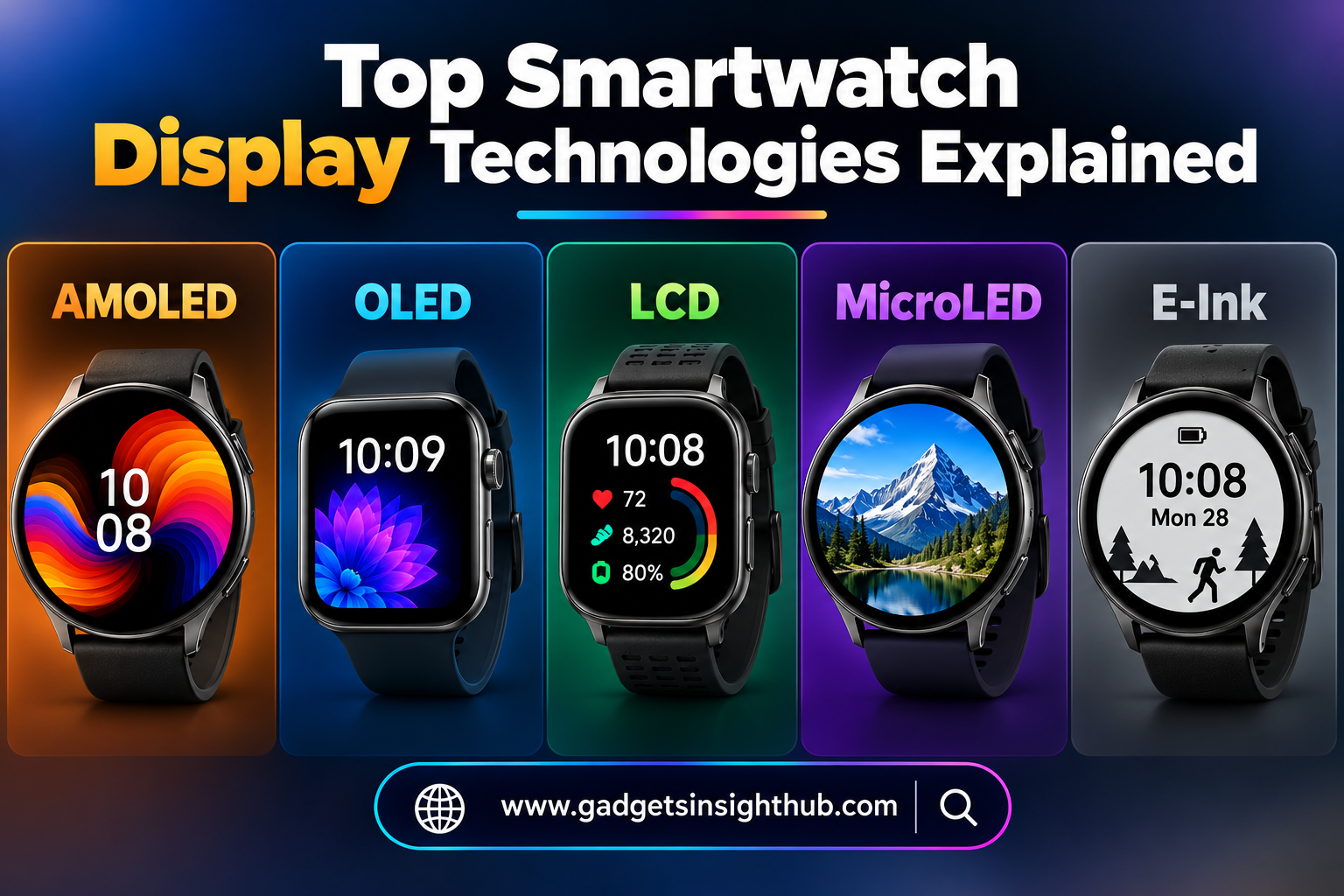
AMOLED, or Active Matrix Organic Light-Emitting Diode, is one of the most popular display technologies used in modern smartwatches. Each pixel produces its own light, allowing the screen to display vibrant colours, deep blacks, and strong contrast.
Because individual pixels can switch off completely, AMOLED displays can show dark interfaces efficiently. This characteristic makes them suitable for always-on display features, although actual battery consumption depends on brightness, screen design, and software settings.
AMOLED technology also supports detailed graphics, smooth animations, and colourful watch faces. These qualities improve the experience of viewing notifications, workout statistics, photographs, and application interfaces.
Another advantage is design flexibility. AMOLED panels can be manufactured in compact shapes suitable for round and rectangular smartwatch screens.
However, bright displays can consume significant power, particularly when users frequently check the screen or enable high brightness. Organic display materials may also experience long-term degradation under certain usage conditions.
AMOLED is a strong choice for users who value attractive visuals, clear text, and an interactive smartwatch experience.
2. OLED Displays
OLED, or Organic Light-Emitting Diode, is a broader display technology category that includes AMOLED. OLED screens use organic materials that emit light when electricity passes through them.
In smartwatch marketing, OLED and AMOLED are sometimes discussed separately, although AMOLED is a type of OLED technology that uses an active-matrix system to control pixels.
OLED-based displays offer excellent contrast because black pixels can remain unlit. They also provide rich colours and wide viewing angles, making information easier to view from different wrist positions.
These characteristics suit smartwatches that display detailed health statistics, colourful interfaces, and animated graphics. Their ability to produce dark backgrounds can also support efficient power use when applications are designed appropriately.
OLED displays may have limitations involving maximum brightness, long-term pixel wear, and power consumption under certain conditions. The exact performance depends on the panel and its implementation.
For most buyers, comparing the actual smartwatch specifications is more useful than focusing only on whether a manufacturer uses the term OLED or AMOLED.
3. LCD Displays
Liquid Crystal Display, commonly known as LCD, is another technology found in electronic devices, including some smartwatches and fitness wearables.
Unlike OLED displays, LCD panels do not generate light independently at each pixel. They use liquid crystals to control how light from a backlight passes through the display.
LCD technology can provide clear text, readable icons, and dependable everyday performance. It may also offer a cost-effective option for entry-level smartwatches.
However, LCD screens generally cannot produce the same deep blacks as OLED displays because their backlights illuminate the panel. Black areas may appear grey, depending on the screen design and lighting conditions.
Backlight operation can also influence power consumption, particularly when the display remains illuminated for extended periods.
LCD remains suitable for users who prioritise affordability and basic functionality over premium visual quality. For fitness trackers and budget wearables, a well-designed LCD may provide everything needed to view notifications and activity information.
4. Memory-in-Pixel Displays
Memory-in-Pixel, or MIP, is a display technology associated with several outdoor and sports-focused watches. It is designed to provide efficient operation and strong readability in bright environments.
MIP displays retain pixel information within the display structure, reducing the need for constant refreshing in certain operating conditions. Many reflective implementations use surrounding light to make the screen visible rather than relying entirely on a continuously illuminated backlight.
This approach can support excellent battery efficiency, particularly when users spend considerable time outdoors. Sunlight can improve visibility, making MIP displays attractive to runners, hikers, cyclists, and endurance athletes.
However, MIP screens may appear less vibrant than AMOLED panels, particularly indoors or in low-light environments. Colours and animations can also look more limited, depending on the implementation.
Some models include a backlight for darker conditions, but using it increases power consumption.
MIP technology is worth considering for people who prioritise long battery life and outdoor readability over colourful graphics.
5. E-Ink Displays
Electronic Ink, commonly called E-Ink, is best known for its use in electronic readers. It is designed to reproduce a paper-like appearance and can be useful in specialised wearable devices.
E-Ink displays reflect ambient light rather than relying on a conventional continuously illuminated screen. This makes them comfortable to view in bright surroundings and potentially very efficient when displaying static information.
Because the image can remain visible without continuous refreshing, E-Ink can support long battery life in suitable devices.
However, traditional E-Ink screens usually refresh more slowly than AMOLED or LCD displays. This limitation makes them less suitable for smooth animations, fast-moving workout information, or highly interactive interfaces.
Colour support and resolution also vary between E-Ink implementations.
E-Ink is most appropriate for specialised wearables that prioritise simple information, low power consumption, and readability. It is less common in mainstream smartwatches because users often expect responsive touch controls and colourful graphics.
6. Transflective Displays
Transflective displays combine reflective and transmissive properties to improve visibility across different lighting conditions.
In bright outdoor environments, these screens can use reflected ambient light to make information easier to read. In darker conditions, a backlight can illuminate the display.
This combination makes transflective technology useful for sports watches and outdoor wearables. It allows users to check activity statistics without depending entirely on a brightly illuminated screen.
Transflective displays can offer a practical balance between outdoor visibility and battery efficiency, although performance depends on the panel design and surrounding lighting.
Their appearance may be less vivid than modern AMOLED screens, and their colour reproduction can vary.
For hikers, runners, and people who spend extended periods outside, transflective displays can be a sensible option. Buyers should compare readability in both bright sunlight and indoor environments before making a decision.
7. MicroLED Displays
MicroLED is an emerging display technology that uses microscopic light-emitting diodes to create images. Like OLED, it can control light at the individual pixel level, but it uses different materials and construction methods.
Potential advantages include high brightness, strong contrast, fast response times, and the possibility of improved durability compared with certain organic display technologies.
These characteristics could make MicroLED attractive for future smartwatches, particularly devices that need excellent outdoor visibility and efficient performance.
However, manufacturing tiny, high-resolution MicroLED panels is technically challenging. Production costs, manufacturing complexity, and commercial availability remain important obstacles.
Consequently, MicroLED should be viewed as a developing technology rather than a standard feature available across mainstream smartwatches.
As manufacturing processes improve, MicroLED could create new possibilities for compact wearable displays. Buyers considering a smartwatch today should focus on currently available products rather than purchasing decisions based on future promises.
8. LTPO Display Technology
LTPO stands for Low-Temperature Polycrystalline Oxide. It is a backplane technology that helps control how individual pixels are driven in compatible displays.
LTPO is commonly associated with premium smartwatch OLED and AMOLED panels. Its major advantage is the ability to support variable refresh rates, allowing the screen to update at different speeds depending on what is being displayed.
For example, a watch showing a mostly static clock may use a low refresh rate, while an interactive interface can refresh more frequently. This flexibility can reduce power consumption compared with operating at a consistently high refresh rate.
The benefits depend on how the manufacturer implements the technology and manages the display through software.
LTPO does not describe a completely separate image-producing technology in the same way as LCD or OLED. Instead, it is part of the system controlling the display.
For buyers, an LTPO-equipped smartwatch may offer a useful combination of smooth interaction and improved battery efficiency, particularly when always-on display functionality is important.
How to Choose the Right Smartwatch Display
Choosing a display starts with understanding how you will use your smartwatch.
If you prefer colourful watch faces, detailed graphics, and responsive interactions, AMOLED or OLED technology is usually a strong option. These displays suit everyday smartwatches that focus on applications, notifications, and attractive interfaces.
For outdoor activities, MIP and transflective displays can be appealing because they prioritise readability and power efficiency in bright environments. They may be especially useful for long hikes, cycling trips, and extended running sessions.
If affordability is your main concern, an LCD-based smartwatch may provide suitable everyday functionality without unnecessary expense. Specialised E-Ink wearables may suit users who prioritise simple information and low power consumption.
Also consider brightness, resolution, screen size, touch responsiveness, and always-on functionality. A display that looks impressive indoors may be less convenient in direct sunlight.
Finally, remember that battery life depends on more than display technology. GPS, wireless connectivity, sensors, software, and usage patterns all influence how often a smartwatch needs charging.
Conclusion
Smartwatch display technologies offer different combinations of visual quality, outdoor readability, and energy efficiency. AMOLED and OLED displays are popular for their vivid colours and strong contrast, while LCD remains a practical choice for affordable devices. MIP and transflective technologies suit outdoor activities, and E-Ink serves more specialised applications.
MicroLED represents a developing opportunity, while LTPO helps compatible displays balance responsiveness with power efficiency.
The best display depends on your priorities. Consider where you use your smartwatch, how frequently you interact with its screen, and how important battery life is to your routine. Comparing real-world performance alongside specifications will help you choose a smartwatch that delivers the right balance of visibility, comfort, and everyday usability.