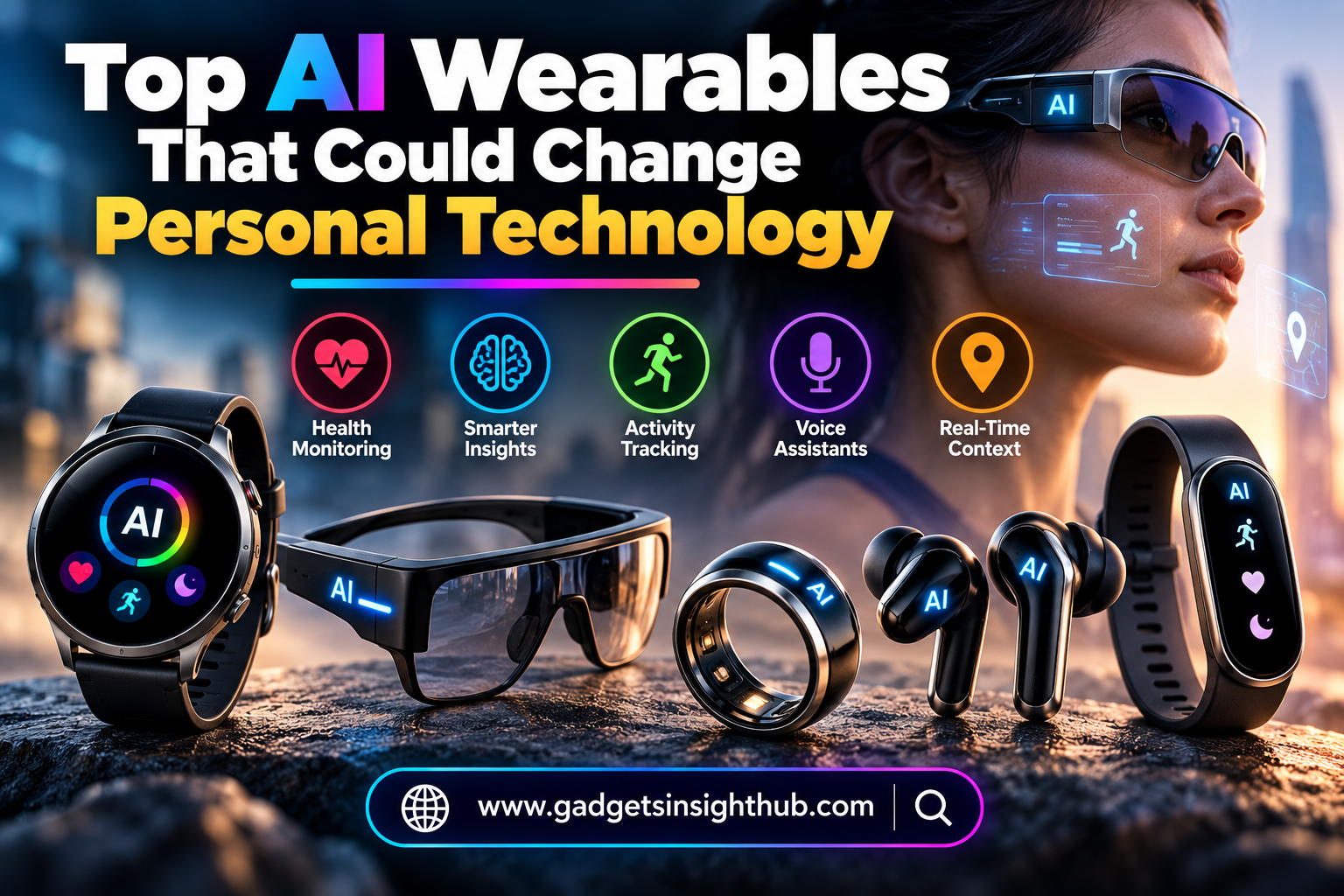
Artificial intelligence is transforming wearable technology by making devices more intelligent, responsive, and personalised. Traditional wearables mainly record steps, heart rate, sleep, and notifications, while AI-powered devices aim to understand information and provide useful assistance. From smart glasses and fitness watches to smart rings and voice-controlled accessories, these innovations are changing how people interact with technology.
AI wearables can help users manage daily tasks, understand activity patterns, access information hands-free, and communicate more conveniently. Some devices already offer AI-assisted features, while others represent developing technologies that may become more common in the coming years.
However, their usefulness depends on practical performance, battery life, privacy protection, comfort, and affordability. Here are seven AI wearable categories and products worth understanding as personal technology continues to evolve.
1. Ray-Ban Meta Smart Glasses
Ray-Ban Meta smart glasses combine familiar eyewear styling with cameras, microphones, speakers, and AI-powered features. They allow users to interact with selected digital services without constantly holding a smartphone.
Depending on the model, region, and software availability, users can ask supported AI questions, capture photographs, record videos, and listen to audio through integrated speakers. Voice interaction makes the glasses convenient when walking, travelling, or performing tasks that require both hands.
AI features can help users obtain information about their surroundings or interact with supported services. However, available capabilities vary, and some functions require an internet connection or a compatible smartphone.
The glasses also raise privacy considerations because they include cameras and microphones. Users should understand recording indicators, respect other people’s privacy, and follow local recording laws.
Ray-Ban Meta smart glasses are particularly interesting because they integrate technology into an everyday accessory rather than introducing an entirely unfamiliar device. Their future development may make hands-free digital assistance more natural, provided that privacy, comfort, and battery limitations are addressed.
2. AI-Powered Smartwatches
Smartwatches are becoming more capable through AI-assisted fitness analysis, voice interaction, and personalised software features. Instead of simply recording measurements, compatible devices can help users interpret activity patterns and access information more conveniently.
For example, a smartwatch may summarise a workout, organise health measurements, or provide suggestions based on recorded activity. Some devices also integrate voice assistants that can answer questions, manage reminders, and control compatible applications.
Products such as the Apple Watch Series 11, Samsung Galaxy Watch8, and Google Pixel Watch 4 provide different combinations of fitness monitoring, connected services, and software assistance. The availability of specific AI features depends on the model, operating system, region, and connected smartphone.
AI-generated health insights should be treated as general guidance rather than medical diagnoses. Users should not make important healthcare decisions based solely on automated recommendations.
Smartwatches are likely to remain among the most practical AI wearables because they already combine familiar functions with established applications. Improvements in software may make them better at presenting relevant information without requiring users to navigate multiple screens.
3. Oura Ring 4 and AI-Assisted Wellness Tracking
Smart rings demonstrate how AI-supported wellness technology can operate without a screen. The Oura Ring 4 collects supported measurements related to sleep, heart rate, activity, and temperature trends, then presents information through a companion application.
Its value lies in helping users recognise patterns across multiple days rather than focusing on isolated readings. The application can provide summaries related to sleep, readiness, and activity, depending on the available features.
AI and algorithmic analysis can make these measurements easier to interpret by organising information into accessible reports. Users may identify changes in sleeping routines or observe how daily activity relates to their general wellness patterns.
However, a smart ring does not directly measure every aspect of health. Sleep stages and recovery scores are estimates, and unusual readings may require further investigation rather than automatic conclusions.
Subscription costs are another consideration because some Oura features require membership.
Smart rings could become more useful as software improves, particularly for people who prefer passive monitoring instead of a constantly visible smartwatch display. Their success will depend on providing reliable insights while protecting sensitive personal information.
4. AI-Enabled Smart Glasses With Visual Assistance
A newer category of wearable technology combines cameras, microphones, and AI systems to help users understand their surroundings. Depending on the product, these glasses may describe visible objects, interpret selected signs, or answer questions about images.
Such capabilities could be useful for travellers, students, professionals, and people who need hands-free access to contextual information. A user might ask for help understanding a sign or request information about an object in view.
These features can reduce the need to take out a phone for every question. However, visual AI systems can misinterpret objects, overlook important details, or provide incorrect answers.
Users should verify important information, particularly when safety, navigation, or technical work is involved. Camera permissions and recording practices also deserve attention.
Visual assistance is especially promising because it connects digital information with the user’s immediate environment. Future devices may combine better cameras, smaller components, and more efficient AI processing to provide assistance with less delay.
For this category to become widely useful, manufacturers must improve accuracy, battery life, comfort, and privacy controls while keeping interactions straightforward.
5. AI-Powered Fitness and Recovery Wearables
AI-assisted fitness wearables aim to make exercise information more personalised. Devices can collect heart rate, movement, sleep, and workout measurements, then analyse patterns to help users understand training and recovery.
Products such as Whoop 5.0 and selected Garmin sports watches provide training and recovery-related insights through their respective software platforms. Some features use algorithmic analysis to estimate exercise strain, sleep needs, or readiness for another workout.
These tools can help athletes organise their training and recognise when their routines become inconsistent. Beginners may also benefit from simple activity summaries and achievable exercise goals.
However, readiness scores and recovery recommendations are estimates, not definitive measures of physical condition. Individual needs vary, and a device cannot fully account for every aspect of health, stress, or training experience.
Subscription requirements and the quality of the companion application should also influence purchasing decisions.
AI-powered fitness wearables could become more useful as they learn to present relevant information without overwhelming users with statistics. The most valuable systems will help people make sensible decisions while allowing them to retain control over their training.
6. AI Earbuds and Voice-Controlled Assistants
Wireless earbuds are evolving beyond music playback and telephone calls. Some models integrate voice assistants, AI-powered communication features, and tools that help users interact with digital services while moving.
Compatible earbuds may allow users to ask questions, manage reminders, control music, or access spoken information without looking at a screen. Depending on the product and software, AI features can also support conversation assistance or language-related tasks.
Examples include selected Apple AirPods, Google Pixel Buds, and other wireless earbuds that connect with supported AI services. Capabilities differ significantly between models, and some functions require a compatible phone or internet access.
These devices are particularly useful during commuting, exercise, and household activities. Voice interaction can make technology feel less intrusive because users do not need to repeatedly handle a smartphone.
Nevertheless, microphones, cloud processing, and continuous connectivity create privacy and battery considerations. Users should review permissions and understand how voice data is handled.
AI earbuds may become an important part of personal technology because audio is already a familiar, convenient way to interact with digital assistants.
7. AI Wearables for Accessibility and Everyday Assistance
AI wearables could provide significant benefits for people who need additional assistance with everyday tasks. Camera-equipped glasses, voice-controlled devices, and connected accessories may help users access information in more convenient ways.
For example, compatible visual assistance tools may describe selected objects, read visible text, or provide contextual explanations. Voice interfaces can also make digital services easier to use for people who find small touchscreens difficult to navigate.
The usefulness of these features depends on individual requirements, device accuracy, accessibility settings, and the environment in which they are used.
AI systems can make mistakes, particularly when visual information is unclear or circumstances change quickly. Users should not rely exclusively on AI wearables for critical navigation, emergency decisions, or other safety-sensitive tasks.
Privacy is equally important when devices capture images, process speech, or store personal information.
As accessibility-focused technology develops, manufacturers should involve people with different needs in product testing and design. Successful devices will provide dependable assistance while preserving user independence, dignity, and control over personal data.
What to Consider Before Buying an AI Wearable
Before purchasing an AI wearable, identify the tasks you want it to perform. Smart glasses may suit hands-free information access, while smartwatches and rings are more appropriate for fitness and wellness tracking. AI earbuds can be useful for voice interaction and communication.
Battery life is important because cameras, microphones, displays, and wireless connections consume power. Check realistic operating estimates rather than relying only on maximum advertised figures.
Compatibility also matters. Some features work only with specific smartphones, applications, subscriptions, or regional services. Confirm these requirements before spending money.
Privacy should be a major consideration. Review which data the device collects, whether information is processed locally or online, and how recordings or health measurements are stored.
Finally, remember that AI-generated information can be inaccurate. Choose devices that explain their limitations and provide useful controls rather than making unsupported promises.
Conclusion
AI wearables are changing personal technology by combining familiar accessories with intelligent software. Smart glasses provide hands-free assistance, smartwatches offer personalised fitness features, and smart rings help users review wellness patterns. AI earbuds and accessibility-focused devices create additional ways to interact with information.
Although these technologies offer promising benefits, their practical value depends on accuracy, comfort, battery life, privacy, and affordability. Not every AI feature is necessary, and some products remain limited by software availability or connectivity requirements.
The best approach is to choose a wearable that solves a genuine problem in your daily routine. As AI becomes more integrated into personal devices, the most successful products will make technology easier to use while protecting privacy and keeping users in control.