Introduction
Wearable technology is changing how people monitor their health, communicate, exercise, and interact with digital devices. From smartwatches and fitness trackers to smart glasses and intelligent clothing, these devices are becoming more useful in everyday life. Improvements in artificial intelligence, sensors, battery technology, and wireless connectivity are helping manufacturers develop wearables that offer more personalized and convenient experiences.
In the coming years, wearable devices are expected to move beyond basic activity tracking. They may provide more detailed health insights, support hands-free communication, improve workplace safety, and make digital information easier to access. Some technologies are already available, while others are still developing and require further testing.
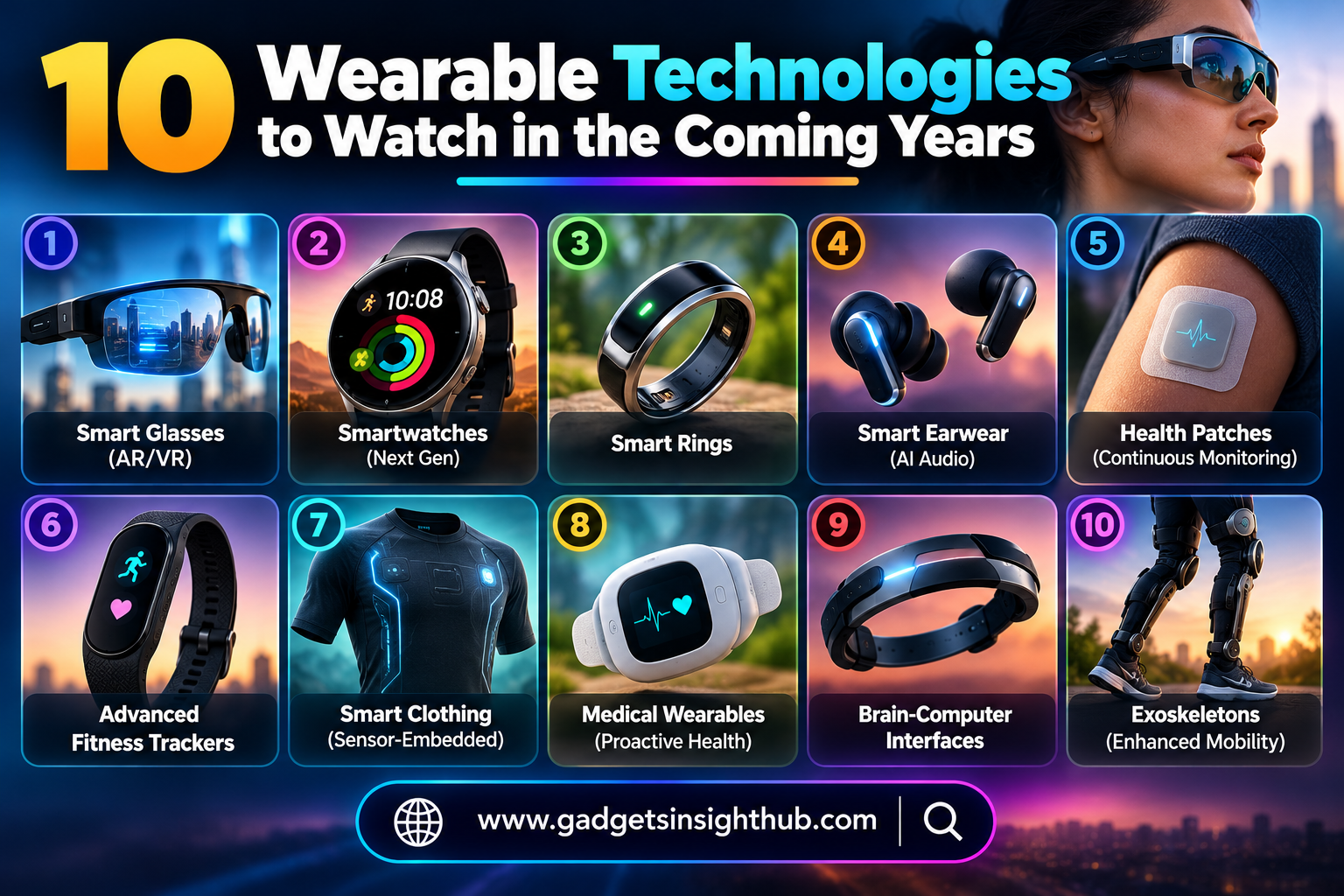
Here are ten wearable technologies worth watching in the coming years.
1. Advanced Smartwatches
Smartwatches remain among the most popular wearable devices because they combine notifications, fitness tracking, communication, and health-related features in one compact product. Future models are likely to become more capable through improved sensors, smarter software, and better integration with smartphones and other connected devices.
Newer smartwatches may offer more personalized activity recommendations, improved sleep analysis, and more detailed workout information. Artificial intelligence could help users understand their collected data by explaining patterns and suggesting adjustments to daily routines.
Battery life is another important area of development. More efficient processors and displays could help devices operate longer between charges.
However, health measurements from consumer smartwatches are not always equivalent to clinical tests. Their accuracy varies by feature and device, so important medical concerns should be discussed with qualified healthcare professionals.
2. Smart Glasses
Smart glasses are developing into a practical alternative to constantly checking smartphones. Depending on the model, they can support audio playback, hands-free calls, photography, voice assistants, and notifications.
Future smart glasses may include more advanced displays that place digital information within the user’s field of view. This could make navigation, translation, and access to instructions more convenient without requiring a person to look down at a screen.
Artificial intelligence may also allow glasses to interpret voice commands and provide context-aware assistance. For example, users might request information about a nearby landmark or receive spoken translations during conversations.
The main challenges include battery capacity, comfort, price, and privacy. Devices with cameras and microphones must make recording practices clear and respect the privacy of people nearby.
3. Smart Rings
Smart rings offer many health and activity tracking functions in a smaller form than a smartwatch. Their compact design makes them appealing to people who prefer not to wear a screen on their wrist.
Current smart rings can track selected measurements such as sleep patterns, heart rate, skin temperature trends, and daily activity. Future versions may improve sensor accuracy, battery efficiency, and the quality of personalized insights.
Because rings do not usually have large displays, users generally review their information through a connected smartphone application. This approach can reduce distractions while keeping useful measurements accessible.
Smart rings may become particularly popular for overnight tracking because some people find them more comfortable than wrist-based devices. Nevertheless, fit, charging requirements, sensor limitations, and subscription costs can influence their usefulness.
4. AI-Powered Health Wearables
Artificial intelligence is becoming an important part of wearable technology. Instead of simply collecting measurements, AI-enabled devices can help identify patterns in activity, sleep, and other recorded information.
For example, an application might identify changes in a user’s usual sleep schedule or show how daily activity varies over several weeks. These insights could help people recognize habits and make informed lifestyle adjustments.
Future systems may combine information from multiple devices to produce a broader picture of daily routines. A smartwatch, smart ring, and connected health application could contribute different types of data to a single dashboard.
However, AI-generated insights depend on data quality and the limitations of the underlying algorithms. Wearables should not be treated as substitutes for professional diagnosis, and users need clear explanations of how their personal information is collected and processed.
5. Smart Clothing and Electronic Textiles
Smart clothing integrates sensors and electronic components into garments such as shirts, jackets, socks, and athletic wear. Unlike wrist-based devices, these products can place sensors closer to specific parts of the body.
Sports clothing may help measure movement, posture, breathing patterns, or muscle activity, depending on the technology used. This information could support athletic training, rehabilitation programs, and movement analysis.
Smart garments may also become useful in workplaces where monitoring movement, temperature, or physical strain can contribute to safety programs. Researchers are exploring flexible electronic materials that can make these systems more comfortable.
The biggest challenges involve durability, washing, power supply, and manufacturing costs. Electronic components must remain reliable while garments stretch, move, and experience regular wear. Wider adoption will depend on making smart clothing affordable and practical for everyday use.
6. Augmented Reality Wearables
Augmented reality, commonly known as AR, adds digital information to a view of the physical world. AR glasses and head-mounted devices can display directions, diagrams, labels, and other visual information while users remain aware of their surroundings.
In the coming years, these devices may become more useful for education, industrial maintenance, design, and remote collaboration. A technician could view repair instructions while working on equipment, while a student might explore a three-dimensional model during a lesson.
Businesses could also use AR wearables to provide employees with visual guidance and remote assistance. This may reduce the need to repeatedly consult separate screens or printed manuals.
For everyday consumers, successful adoption will depend on lighter designs, clear displays, longer battery life, and reasonable prices. Developers must also address visual comfort, safety, and the amount of attention digital overlays demand.
7. Continuous Health Monitoring Devices
Wearables are increasingly being designed to monitor selected health measurements throughout the day. Depending on the product, these may include heart rate, activity, sleep, skin temperature, or blood oxygen estimates.
Future devices may offer improved monitoring capabilities and better ways to identify unusual changes from a person’s normal patterns. Some specialized wearable systems already support particular medical monitoring needs, while other applications remain under research or regulatory review.
Continuous monitoring could help users maintain records to discuss with healthcare professionals. It may also support remote care when a suitable device is used as part of an established medical program.
Nevertheless, collecting more data does not automatically lead to better health outcomes. Accuracy, false alerts, access to professional advice, and protection of sensitive health information remain important considerations.
Consumers should check which measurements a device actually supports and whether its intended medical use has been appropriately authorized.
8. Wearable Translation Devices
Language barriers can make travel, education, and international business more difficult. Wearable translation technology aims to make conversations easier by converting spoken language into another language, often through earbuds, microphones, or smart glasses.
Future devices may deliver faster translations, support more languages, and handle natural conversation more effectively. Improved speech recognition could help systems deal with different accents and ordinary background noise.
Translation earbuds may allow two people to communicate while each listens to translated speech. Smart glasses could potentially display translated text, making them useful in situations where audio is inconvenient.
However, performance can vary depending on internet connectivity, language support, speaking speed, and environmental noise. Some systems may also require a smartphone or cloud service.
Privacy is another consideration because translation tools may process conversations containing personal or confidential information. Clear data policies and reliable offline options could make these products more attractive.
9. Wearables for Workplace Safety
Wearable technology is becoming relevant to industries such as construction, manufacturing, logistics, and emergency response. Depending on the system, devices can track worker location, provide alerts, measure environmental conditions, or help identify situations that require attention.
Smart helmets, connected safety vests, and wearable sensors may help workers receive warnings about certain hazards. In physically demanding environments, appropriate sensors could also support efforts to understand heat exposure or fatigue-related risks.
Future workplace wearables may combine sensor information with intelligent software to provide more timely warnings. Integration with existing safety systems could help supervisors respond to problems more effectively.
These devices should support, rather than replace, established workplace safety procedures. Poorly designed monitoring can create privacy concerns, and inaccurate alerts may distract workers. Employers need transparent policies, reliable equipment, and clear limits on how collected data is used.
10. Neural and Gesture-Control Wearables
Gesture-control technology allows people to operate digital devices through movements rather than conventional buttons or touchscreens. Some systems already recognize hand gestures, while others use sensors to interpret muscle activity or subtle movements.
Future wearable interfaces may make it easier to control smart home devices, computers, and augmented reality systems without directly touching a screen. For example, a user might select an item in a digital interface using a hand movement or control a device through muscle signals detected by a wearable band.
Neural interfaces represent a more advanced research area. Certain systems are being investigated to help people with disabilities interact with computers or communication tools. Their capabilities, accessibility, and practical uses vary significantly.
These technologies face challenges involving signal accuracy, comfort, cost, and learning requirements. More advanced neural systems may also raise significant questions about privacy, consent, and responsible handling of sensitive biological data.
What Will Drive Wearable Technology Forward?
Several developments will influence which wearable technologies become widely adopted.
Artificial intelligence may help devices turn raw measurements into more understandable information. Improved batteries and energy-efficient components could make wearables smaller and reduce charging frequency. Better sensors may support more reliable measurements, while faster wireless connections could improve communication between devices.
Design will remain equally important. People are more likely to use wearable products consistently when they are comfortable, durable, easy to operate, and reasonably priced.
Privacy and security will also influence consumer trust. Wearables can collect information about movements, routines, conversations, and health-related measurements. Manufacturers must provide clear privacy controls, secure data storage, and understandable explanations of how information is shared.
Conclusion
Wearable technology is moving beyond basic fitness tracking toward more connected and personalized experiences. Advanced smartwatches, smart glasses, smart rings, AI-powered health tools, smart clothing, augmented reality devices, translation wearables, workplace safety systems, and gesture-control interfaces all have potential to influence daily life.
However, not every emerging technology will become mainstream. Practical benefits, affordability, comfort, accuracy, privacy, and battery performance will determine which products succeed.
For consumers, the best approach is to choose wearable devices that solve genuine problems rather than buying products simply because they feature new technology. As innovation continues, wearables may become increasingly useful companions for health awareness, communication, work, and everyday convenience.