
Technology changes how you work, communicate, learn, and manage everyday tasks. While smartphones, wireless earbuds, and smartwatches are already common, a new generation of devices is beginning to offer more convenient ways to handle daily activities. From smart glasses that display useful information to compact health trackers and AI-powered assistants, several Gadgets That Could Become Mainstream may soon find a regular place in your life.
You do not necessarily need another screen or complicated device. You need technology that saves time, solves real problems, and works smoothly with the products you already own. That is why the next wave of consumer gadgets will depend on practical features, reasonable prices, reliable software, and comfortable designs.
Here are 10 promising gadgets that could become more widely used over the next few years, along with the everyday benefits and limitations you should understand before buying them.
1. AI-Powered Smart Glasses
Smart glasses could become more popular as manufacturers find better ways to combine wearable technology with ordinary eyewear. Instead of taking your phone out of your pocket every few minutes, you may be able to access selected digital features through glasses.
Depending on the model, these devices can include cameras, microphones, speakers, voice assistants, and hands-free controls. Some designs focus on taking photos and playing audio, while others explore visual displays that place digital information in your field of view.
How you could use them:
- Capture photos or short videos without holding a phone.
- Listen to navigation instructions while walking.
- Ask an AI assistant questions using voice commands.
- Access notifications or translations on compatible models.
For example, if you travel frequently, smart glasses with audio navigation could help you follow directions while keeping your hands free.
However, you should check battery life, prescription-lens support, privacy controls, and smartphone compatibility. Models with advanced displays may also be more expensive and less comfortable than ordinary glasses.
2. AI Voice Recorders and Personal Note-Taking Devices
If you regularly attend meetings, classes, interviews, or brainstorming sessions, an AI-powered recording gadget could make your routine easier. These devices capture audio and may use compatible software to convert speech into text, summarize discussions, or identify important points.
Unlike a basic voice recorder, an AI note-taking device can help you find useful information without listening to an entire recording again.
Practical benefits include:
- Creating searchable transcripts of recorded conversations.
- Organizing meeting notes into summaries.
- Identifying tasks and follow-up points.
- Reviewing important details from lectures or interviews.
Imagine recording a project meeting and later searching the transcript for a deadline or a specific decision. This can save time when you need to review several conversations.
Before choosing one, check whether transcription supports your language and accent. Some services require subscriptions or an internet connection, while recording laws and consent requirements may vary by location.
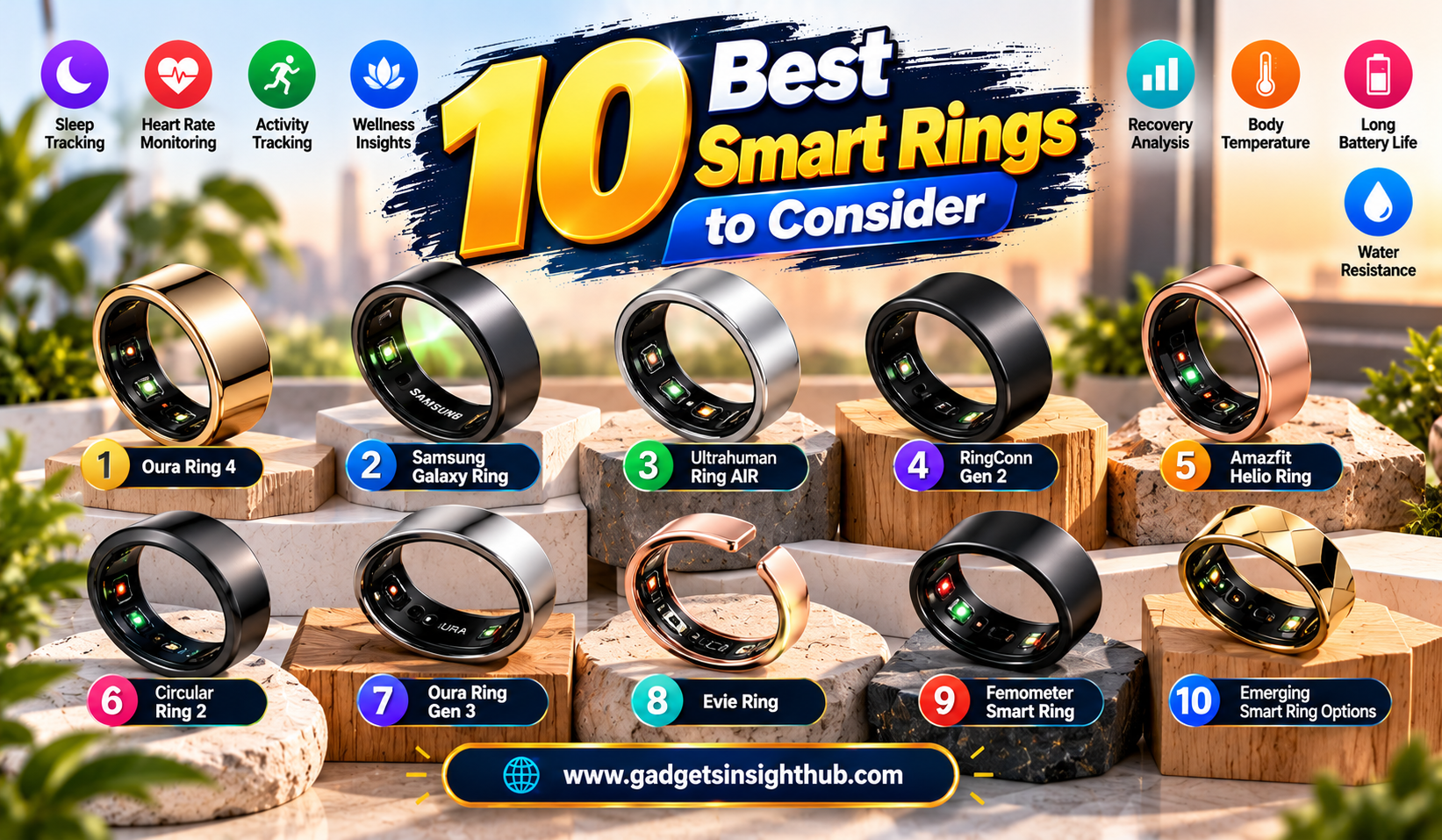
3. Smart Rings for Everyday Health Tracking
Smart rings offer another way to track selected health and activity measurements without wearing a large device on your wrist. Their compact designs may appeal to people who prefer traditional watches or dislike wearing a smartwatch throughout the day.
Depending on the product, a smart ring can track sleep patterns, resting heart rate, activity, and other measurements derived from its sensors. Certain models also estimate changes in skin temperature.
You could use these readings to understand your sleep habits, compare activity levels, and notice patterns in your daily routine.
For instance, reviewing your sleep data over several weeks may help you identify whether late-night screen use or an inconsistent bedtime coincides with poorer sleep.
However, smart rings are not replacements for medical equipment. Measurements can vary in accuracy, and features differ between models. You should also check sizing, charging arrangements, smartphone compatibility, and any recurring membership fees before purchasing one.
4. Augmented Reality Glasses and Lightweight Headsets
Augmented reality (AR) technology places digital information over your view of the real world. While early consumer devices have faced challenges involving cost, comfort, and limited applications, lighter designs could make AR more practical.
Unlike a fully immersive virtual reality headset, an AR device aims to let you remain aware of your surroundings while viewing useful digital content.
Potential applications include:
- Following visual instructions while repairing equipment.
- Viewing navigation prompts during travel.
- Displaying reference material while studying.
- Accessing additional screens for compatible computers.
Consider a situation where you are assembling furniture. An AR application could potentially display step-by-step instructions within your field of view instead of requiring you to repeatedly check a phone or printed manual.
Nevertheless, the experience depends on the hardware and software. Some products marketed as AR glasses primarily display a virtual screen rather than placing interactive objects accurately into your physical environment. Check the actual capabilities before buying.
5. Portable Power Stations for Home and Travel
Portable power stations could become increasingly useful as more people depend on electronic devices for work, travel, and emergency preparation.
These rechargeable units typically contain a battery, power-management electronics, and multiple output ports. Depending on the model, you may be able to charge phones, laptops, cameras, lights, and selected household devices.
Unlike a small power bank, a larger power station can offer substantially more capacity and may support AC outlets, USB ports, and other connections.
Where you could use one:
- Keeping essential electronics running during a power cut.
- Charging devices while camping.
- Supporting remote work away from conventional outlets.
- Powering small appliances within the station’s rated limits.
For example, a freelance designer working during an electricity interruption could use a suitably sized unit to keep a laptop and mobile phone charged.
Before purchasing, compare battery capacity in watt-hours, output power, charging speed, battery chemistry, and the power requirements of your equipment. A power station cannot run every appliance, and its available runtime depends on the connected load.
6. E-Ink Tablets for Reading and Digital Writing
E-ink tablets provide a paper-like reading and writing experience using electronic ink displays. They could appeal to students, professionals, writers, and anyone who prefers handwritten notes but wants to reduce paper use.
Many models support digital notebooks, document annotation, PDF reading, and stylus input. Some also provide handwriting recognition or cloud synchronization.
You could use one to organize lecture notes, review lengthy reports, annotate research papers, or maintain a digital journal.
For example, instead of carrying several notebooks to a meeting, you could keep your notes and reference documents on one device.
E-ink screens generally work differently from conventional LCD and OLED displays. They are often comfortable for reading static text and may offer long battery life, but refresh rates, colour reproduction, and video performance can be limited.
You should also verify file-format support, handwriting features, stylus availability, and whether cloud services require an additional payment.
7. Smart Home Energy Monitors
Smart home energy monitors could become more relevant as households look for practical ways to understand electricity consumption. These devices measure energy use at a plug, appliance, circuit, or whole-home level, depending on their design.
Compatible systems may display consumption through a mobile app, helping you identify equipment that uses more electricity than expected.
For example, you could compare the energy consumption of a desktop computer, air conditioner, or water heater over a typical period. That information may help you decide whether changing usage habits or replacing an inefficient appliance makes sense.
Some smart plugs also offer schedules and remote switching, although not every plug supports energy monitoring.
Before buying, confirm electrical ratings, local voltage compatibility, Wi-Fi requirements, and whether installation needs a qualified electrician. Whole-home monitors and individual smart plugs have different capabilities, so choose a device that matches your needs.
8. Compact Home Robots for Specific Tasks
Home robots are moving beyond the idea of a single machine that can perform every household chore. More practical devices focus on particular tasks, such as vacuuming floors, mowing lawns, cleaning pools, or monitoring selected areas of a home.
This task-specific approach could make household robotics more useful because the device has a clearly defined job.
For example, a robot vacuum with suitable mapping features can clean selected rooms according to a schedule. A compatible model may also avoid certain obstacles or return to its charging station automatically.
Other robots can handle outdoor maintenance or provide remote camera access, depending on their design.
However, you should not expect complete independence. Robots can struggle with clutter, stairs, uneven surfaces, tangled cables, and complicated room layouts.
Compare navigation technology, maintenance requirements, replacement parts, obstacle detection, and the availability of software updates. A robot is most useful when its capabilities match the environment in which you plan to use it.
9. Wearable Translation Devices
Language barriers can make international travel, business meetings, and conversations with new people more difficult. Wearable translation devices could help by combining microphones, speakers, and speech-processing software to translate conversations.
Some products use earbuds, while others rely on handheld devices or dedicated wearable hardware. Their capabilities vary, so you should not assume that every model provides instant, two-way translation.
Possible uses include:
- Understanding common phrases while travelling.
- Following conversations during business visits.
- Communicating with people who speak another supported language.
- Accessing translated audio or text through compatible applications.
Imagine visiting a country where you do not speak the local language. A translation-enabled earbud could help you understand basic directions or communicate simple requests.
Still, accuracy depends on language support, background noise, internet access, and the complexity of the conversation. Idioms, regional accents, and technical vocabulary may cause errors.
Check supported language pairs, offline translation options, privacy policies, and whether both speakers need compatible devices. For important legal, medical, or official conversations, professional interpretation may remain necessary.
10. Modular Smartphones and Repairable Electronics
Modular and repairable electronics offer a different approach to upgrading technology. Rather than replacing an entire device whenever one component fails, you may be able to repair selected parts or replace supported modules.
In smartphones and other electronics, repairability can involve replaceable batteries, accessible screens, standard fasteners, and manufacturer-supported spare parts. Fully modular designs are less common, but repair-focused products demonstrate how longer device lifespans can become a design priority.
For example, if a compatible phone has a replaceable battery, you may be able to restore much of its everyday usability without purchasing an entirely new handset.
This approach can reduce electronic waste and help you retain a familiar device for longer.
However, repairable does not automatically mean easy or inexpensive to repair. Parts availability, software support, repair costs, water resistance, and specialist tools all matter.
Before buying, examine the manufacturer’s repair documentation, warranty terms, spare-parts policy, and expected software-support period.
How to Choose Gadgets That Could Become Mainstream
New technology can be exciting, but you do not need to buy every emerging device. The best purchase is one that solves a recurring problem without adding unnecessary expense or complexity.
Use these checks before spending your money:
- Identify a real need: Choose a gadget that improves a task you perform regularly.
- Check compatibility: Confirm support for your smartphone, operating system, computer, and existing accessories.
- Calculate the total cost: Include subscriptions, replacement parts, accessories, and repairs.
- Review privacy controls: Understand what data the device collects and where it is processed.
- Look beyond marketing: Read independent reviews and examine real-world limitations.
- Consider long-term support: Check software updates, battery replacement, warranty coverage, and repair options.
You should also consider whether an ordinary smartphone app or an existing accessory can provide the same benefit. Sometimes, the simplest solution offers better value than a dedicated gadget.
Conclusion
The next generation of consumer technology will not succeed simply because its devices look futuristic. Products that offer clear benefits, reliable performance, reasonable pricing, and easy integration into daily routines have a stronger chance of reaching wider audiences.
These Gadgets That Could Become Mainstream include AI-powered smart glasses, personal note-taking devices, smart rings, AR wearables, portable power stations, e-ink tablets, energy monitors, home robots, translation devices, and repairable electronics.
You can explore these technologies without rushing into every new release. Focus on the features you will actually use, check compatibility carefully, and compare long-term costs before making a purchase. That way, you can adopt useful innovations when they are ready for your needs rather than paying extra for features you rarely use.
Frequently Asked Questions
1. Which gadgets could become mainstream in the next few years?
AI-powered smart glasses, smart rings, e-ink tablets, wearable translation devices, and practical home robots are among the products that could reach more consumers as their usability and affordability improve.
2. Are emerging gadgets worth buying right now?
Emerging gadgets can be worth buying if they solve a specific problem, meet your compatibility requirements, and provide enough value to justify their purchase and ongoing costs.
3. Will AI-powered gadgets replace smartphones?
AI-powered gadgets may handle selected tasks more conveniently, but smartphones are likely to remain important because they combine communication, computing, photography, navigation, and access to numerous applications.
4. How can you choose a reliable new technology gadget?
You should compare independent reviews, supported features, device compatibility, privacy protections, warranty coverage, repair options, and total ownership costs before purchasing a new gadget.