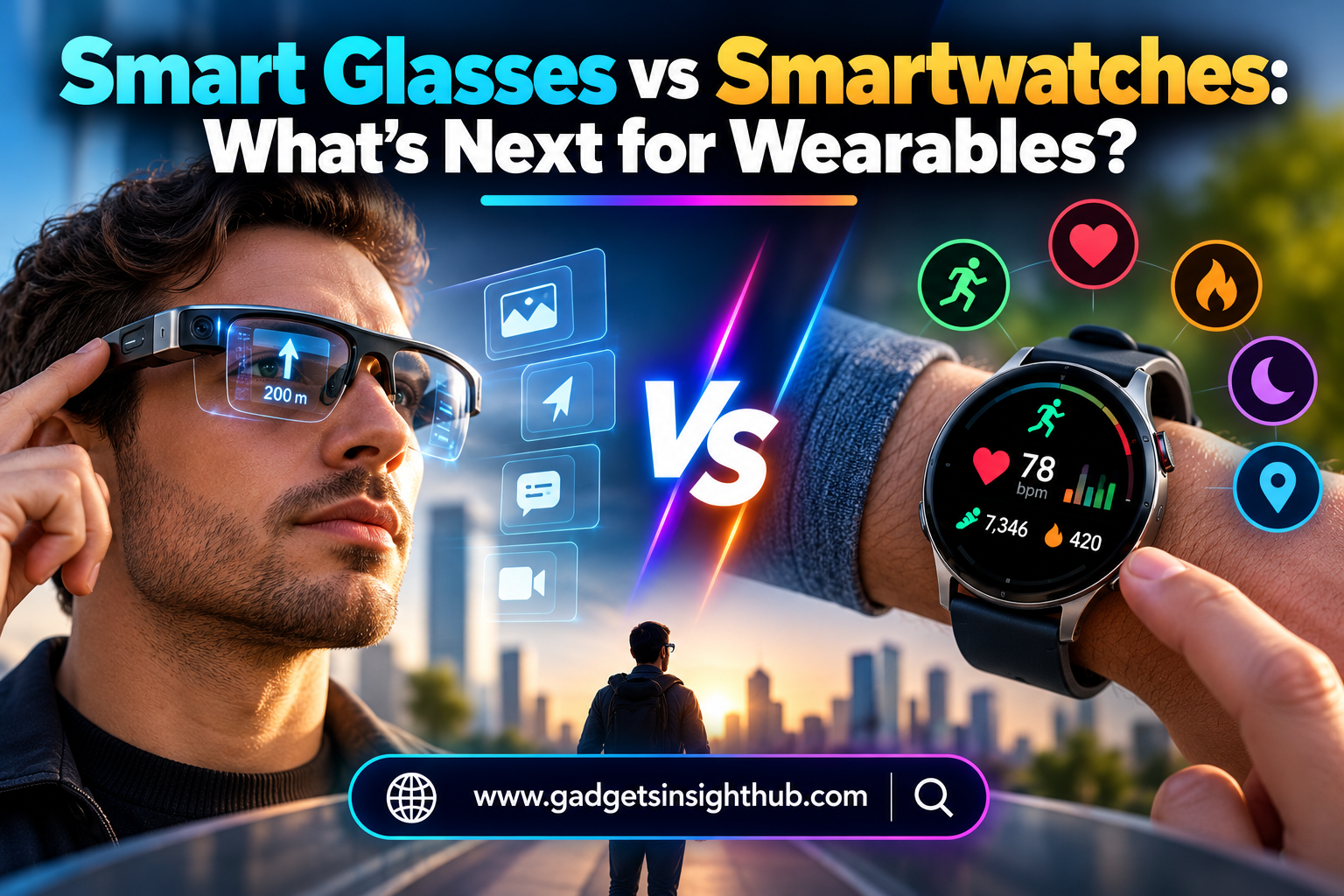
Wearable technology is changing how people communicate, monitor fitness, access information, and interact with digital services. Smart glasses and smartwatches represent two important directions in this evolution. While smartwatches bring notifications, fitness tracking, and applications to the wrist, smart glasses aim to provide hands-free assistance through cameras, audio, artificial intelligence, and visual displays.
Both devices offer practical benefits, but they serve different purposes. Smartwatches are already established tools for everyday organisation and health monitoring, while smart glasses are developing into more advanced personal computing devices. Understanding their differences can help consumers decide which technology suits their lifestyle and what the future of wearables may look like.
1. Understanding Smart Glasses
Smart glasses combine conventional eyewear with electronic components that provide digital functions. Depending on the model, these components may include cameras, microphones, speakers, wireless connectivity, and small displays.
Some products focus on audio, photography, and voice assistants, while others provide visual information directly within the user’s field of view. This allows people to interact with selected digital services without constantly holding a smartphone.
For example, compatible smart glasses may support hands-free calls, music playback, photography, and AI-assisted questions. Models with visual displays can potentially provide navigation instructions, notifications, or contextual information.
Products such as Ray-Ban Meta smart glasses demonstrate how technology can be incorporated into familiar eyewear designs. More advanced augmented reality devices explore ways to combine digital content with the physical environment.
However, features vary considerably between models. Battery life, privacy controls, comfort, and display capabilities remain important considerations.
Smart glasses are particularly appealing to people who want hands-free access to information while walking, travelling, working, or performing everyday tasks.
2. Understanding Smartwatches
Smartwatches are wrist-worn devices that combine fitness monitoring, communication, and digital organisation. They usually include a display that allows users to check information and interact with applications directly.
Modern models can monitor heart rate, record workouts, track sleep, count steps, and provide smartphone notifications. Many also support GPS navigation, contactless payments, music controls, and voice assistants.
Examples include the Apple Watch Series 11, Samsung Galaxy Watch8, and Google Pixel Watch 4. Sports-focused alternatives from Garmin provide additional training and outdoor navigation features.
One major advantage of smartwatches is their established functionality. Users can quickly check messages, start a workout, review activity statistics, or manage reminders without opening a phone.
However, screen size limits how much information can be displayed comfortably. Battery life also varies according to the device, settings, and usage.
Smartwatches are particularly useful for people who want a convenient combination of fitness tracking, notifications, and everyday productivity.
3. Smart Glasses vs Smartwatches: Main Differences
The most important difference is how users access information. Smartwatches provide a visible screen on the wrist, while smart glasses aim to make digital interaction more natural and hands-free.
Smartwatches are generally better for reviewing detailed statistics, responding to notifications, and controlling applications. Smart glasses can be more convenient when users need to keep their hands free or receive information while looking ahead.
Their primary functions also differ. Smartwatches are well suited to activity monitoring and personal organisation, whereas smart glasses are increasingly focused on audio interaction, visual assistance, and augmented reality.
Comfort is another consideration. Some users prefer wearing a watch, while others may find glasses more natural because they already wear eyewear. People who do not normally wear glasses may need time to adjust to their weight and fit.
Neither device completely replaces the smartphone today. Instead, both provide different ways to access selected functions without repeatedly taking a phone out of a pocket or bag.
4. Fitness and Health Monitoring
Smartwatches currently have a strong advantage in fitness and wellness tracking. Their sensors and software are designed to monitor movement, heart rate, workouts, and sleep-related measurements.
Runners can use GPS tracking to record distance and pace, while cyclists can review routes and exercise statistics. Some models also provide recovery estimates and training analysis.
Smart glasses can support exercise through audio instructions, hands-free recording, and selected navigation features. However, most models are not designed to provide the same detailed physiological monitoring as dedicated fitness watches.
Future smart glasses may integrate additional sensors or work more closely with other wearables. This could create connected systems in which glasses provide instructions while a watch records physical activity.
Nevertheless, health measurements require careful interpretation. Consumer wearables provide estimates, and their readings should not replace professional medical assessments.
For people whose main priority is fitness tracking, a smartwatch remains the more practical choice. Smart glasses are better suited to supplementary assistance rather than comprehensive health monitoring.
5. Artificial Intelligence and Voice Interaction
Artificial intelligence is creating new opportunities for both wearable categories. Smartwatches can use AI-assisted features to summarise information, interpret activity patterns, and make selected tasks easier.
Smart glasses have a different advantage: they can combine voice interaction with information about the user’s surroundings. Depending on their capabilities, users may ask questions about visible objects, obtain contextual assistance, or interact with compatible digital services.
This approach could reduce the need to search manually on a smartphone. For example, a traveller might request information about a landmark while continuing to explore a city.
However, AI-generated answers can be incorrect or incomplete. Visual systems may misidentify objects, and voice assistants may misunderstand requests.
The quality of these experiences depends on processing power, internet connectivity, software development, and privacy protections.
In the future, smartwatches and smart glasses may work together, with AI coordinating information across devices. The goal will be to provide useful assistance without requiring users to manage several separate interfaces.
6. Battery Life and Everyday Convenience
Battery life affects how practical a wearable becomes. Smartwatches use power for displays, sensors, GPS, wireless connections, and applications. Feature-rich models may require frequent charging, while some sports watches last several days or longer.
Smart glasses face different challenges. Cameras, microphones, speakers, wireless connectivity, and visual displays must fit within a relatively small frame. Adding advanced features without increasing weight or reducing battery life is difficult.
Audio-focused glasses may use less power than models with continuous visual displays, although performance varies between products.
Charging arrangements also influence convenience. Smartwatches generally use dedicated chargers, while some smart glasses rely on specialised cases or charging accessories.
For both categories, actual battery performance depends on how frequently features are used.
Future improvements in processors, batteries, and energy-efficient software could make wearables more useful throughout the day. Until then, buyers should compare realistic operating times with their normal routines.
7. Privacy and Security Concerns
Privacy is one of the most important issues facing wearable technology. Both smart glasses and smartwatches can collect personal information, but the types of data they capture may differ.
Smartwatches can store health measurements, location information, activity records, and notifications. This information should be protected through appropriate account security, permission controls, and transparent data policies.
Smart glasses introduce additional concerns when they include cameras and microphones. People nearby may not know when recording is taking place, creating potential problems in workplaces, public spaces, and private settings.
Manufacturers should provide clear recording indicators, secure storage, and understandable privacy settings. Users should also respect other people’s privacy and follow applicable recording laws.
AI features may require additional data processing, sometimes through connected services. Buyers should understand whether information is processed on the device or sent to external servers.
Trust will strongly influence the future of wearables. Devices that offer useful features while giving users meaningful control over personal information are more likely to gain wider acceptance.
8. Augmented Reality and the Future of Smart Glasses
Augmented reality allows digital information to appear alongside the physical world. In smart glasses, this could mean displaying directions, translating selected text, showing work instructions, or presenting contextual information without requiring a separate screen.
These capabilities could be useful in education, tourism, industrial maintenance, and professional training. Workers might receive visual instructions while keeping their hands available for practical tasks.
However, advanced augmented reality requires accurate positioning, responsive displays, sufficient processing power, and comfortable hardware. These requirements can increase cost and battery consumption.
Not all smart glasses support augmented reality. Some provide audio and camera features without displaying digital content in front of the eyes.
Smartwatches may continue serving as companion devices by providing controls, notifications, and health information while glasses handle visual assistance.
As hardware improves, smart glasses could become more capable personal computing devices. Wider adoption will depend on practical benefits, affordable prices, comfortable designs, and responsible privacy practices.
9. Which Device Should You Choose?
The right choice depends on your daily activities and priorities.
Choose a smartwatch if you want detailed fitness tracking, convenient notifications, workout statistics, contactless payments, and an established application ecosystem. It is especially suitable for runners, gym users, busy professionals, and people who want to monitor everyday activity.
Choose smart glasses if you value hands-free communication, audio access, photography, or AI assistance while moving through your environment. They may suit travellers, content creators, and people who frequently perform tasks that require both hands.
Before buying smart glasses, check whether they include a display or only audio and camera features. Also consider prescription compatibility, battery life, recording indicators, and software support.
For smartwatches, verify smartphone compatibility, battery performance, sensor capabilities, and the availability of applications you use regularly.
Some people may eventually benefit from owning both devices, but purchasing two wearables is not necessary for most users. Start with the technology that solves your most important everyday problem.
Conclusion
Smart glasses and smartwatches represent different approaches to wearable technology. Smartwatches currently excel at fitness monitoring, notifications, and personal organisation, while smart glasses are developing around hands-free interaction, AI assistance, and augmented reality.
Their future may involve greater integration rather than direct competition. A smartwatch could monitor activity while smart glasses provide directions or contextual information, allowing each device to perform the tasks it handles best.
However, improvements in technology must be accompanied by better battery life, comfortable designs, reliable software, and stronger privacy protections.
For now, smartwatches remain the more versatile choice for fitness and everyday management, while smart glasses offer exciting possibilities for hands-free computing. As both categories develop, the most successful wearables will be those that make technology genuinely useful without adding unnecessary complexity to daily life.